Part 1: The Diamond Ring That Destroyed His Trust
Emiliano Vargas was only thirty-two years old, yet he had already built a fortune that most people could scarcely imagine. As a successful real estate and technology entrepreneur in Mexico City, he owned luxury properties, drove expensive cars, and lived in a magnificent mansion in Lomas de Chapultepec. His life revolved around business meetings, exclusive restaurants, and investments worth millions. He believed that success came from discipline, intelligence, and the ability to recognize weakness before someone could take advantage of him. Unfortunately, he had allowed that belief to shape the way he treated the people around him. His employees received their salaries on time, but he rarely asked about their families.
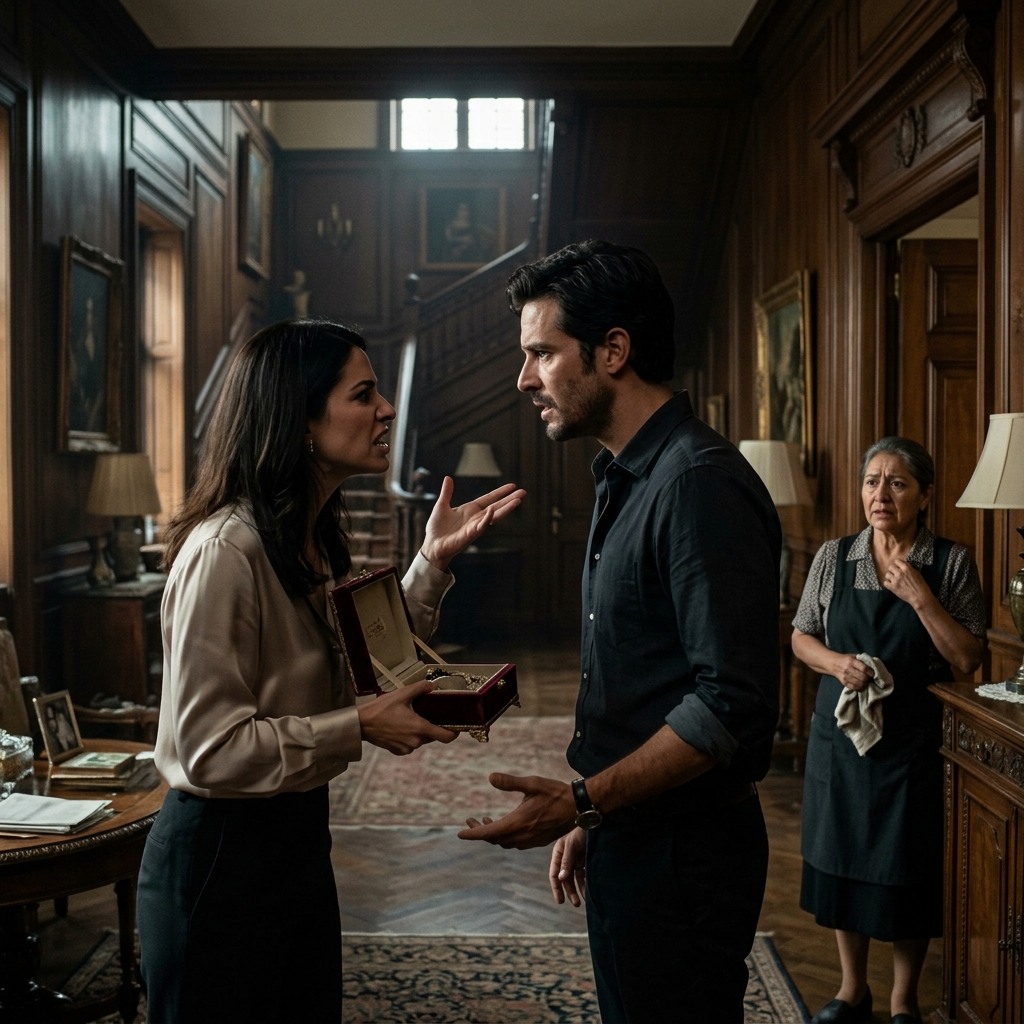
He expected perfection from everyone working in his home and considered personal problems an inconvenience. Among those employees was Rosa Martínez, a quiet housekeeper who had worked for him for three years. Every morning, she arrived before sunrise, tied her hair back, and began cleaning the enormous house. She polished the marble floors, arranged fresh flowers, prepared simple breakfasts, and made sure every room looked untouched. Rosa never demanded attention, never complained about the long hours, and never tried to impress her wealthy employer. Emiliano barely knew anything about her life outside the mansion. He knew she lived somewhere on the outskirts of the city, that she took public transportation to work, and that she sometimes checked her phone during her lunch break. He had never asked why she occasionally looked worried or why she always refused the leftover food that other employees took home—until a Friday afternoon when everything changed. His fiancée, Valeria, came rushing down the staircase with an expression of fury. Her diamond engagement ring had disappeared. The ring was custom-made and worth more than 400,000 Mexican pesos, and she insisted that she had left it on the bedroom dressing table that morning. “I know who took it,” she declared, pointing toward the hallway where Rosa had been cleaning earlier. “She was the only person in our bedroom today.” Emiliano frowned. “Are you certain you left it there?” Valeria stared at him as if he had insulted her. “Why would I accuse someone without a reason? You saw her acting strangely this morning.” He remembered seeing Rosa near the kitchen, hurriedly placing a bulky plastic bag inside her old black backpack. At the time, he had thought little of it. Now the memory seemed like undeniable evidence. “Bring her here,” Valeria demanded. “I want her searched, and if the ring is missing, I want the police involved.” Rosa appeared a few minutes later, drying her hands on a small towel. When Emiliano asked whether she had seen the ring, she looked genuinely confused. “No, señor. I haven’t touched any jewelry.” Valeria folded her arms. “Then you won’t mind if we check your bag.” Rosa’s face grew pale. “I have nothing that belongs to you.” Her answer sounded firm, but Emiliano interpreted her nervousness as guilt.
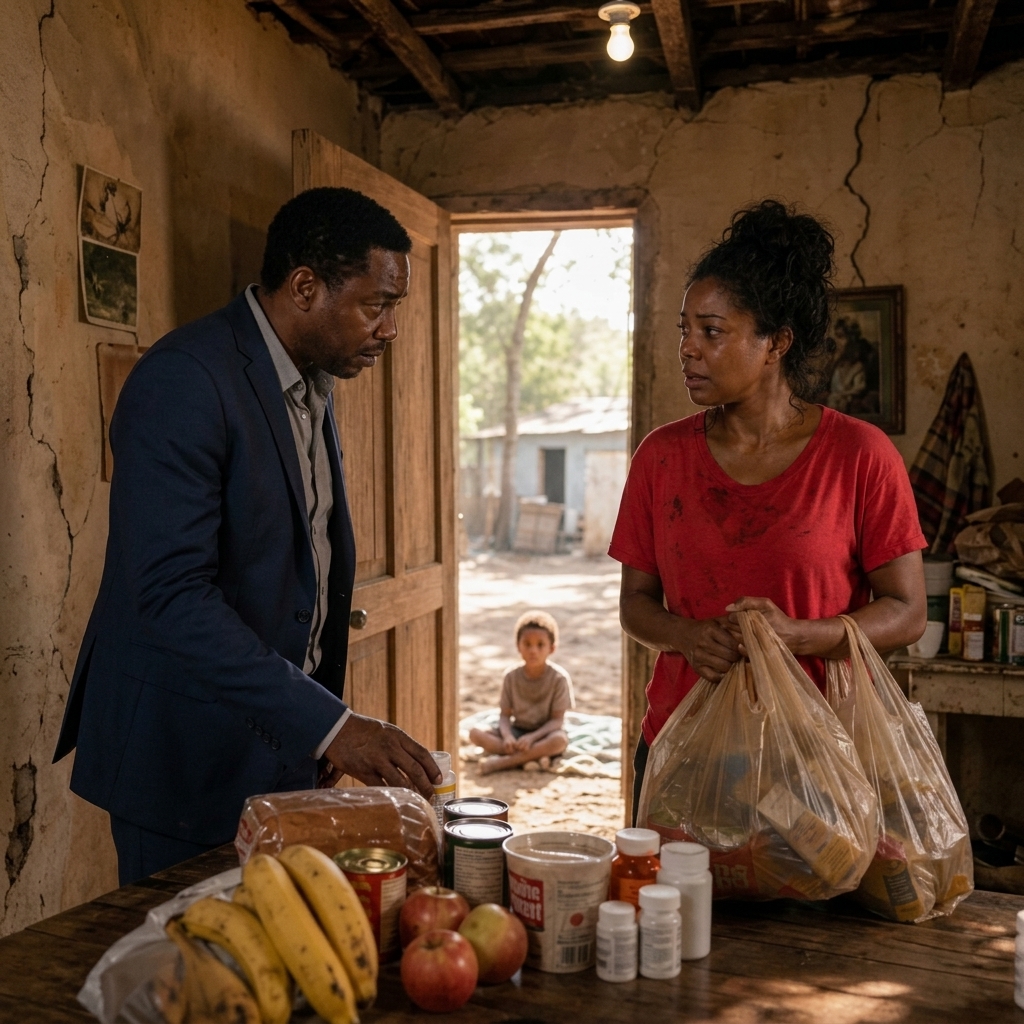
He ordered her to open her backpack. Inside were a worn purse, a small container of food, a folded cardigan, and several household items wrapped in a plastic bag. The ring was not there. Rather than reconsidering the accusation, Valeria insisted Rosa must have hidden it somewhere else. Emiliano dismissed the housekeeper for the day and told her not to return until he had decided what to do. Rosa looked at him with an expression he could not understand. “Please, señor,” she said quietly, “don’t judge me before you know the truth.” But he had already made up his mind. After she left, he checked the security cameras and discovered that the bedroom recording had a gap caused by a technical issue. There was no clear footage proving she had taken anything, but there was also nothing that immediately explained the ring’s disappearance. Valeria continued demanding that he report Rosa to the police. Emiliano, however, wanted to confront her personally. He wanted to see the evidence with his own eyes and make her admit what he believed she had done. Using the address listed in her employment records, he got into his red Mercedes and followed the route toward Valle de Chalco. As the journey continued, the polished avenues gave way to crowded streets, uneven roads, small shops, and modest concrete houses. When his navigation system announced that he had arrived, he found himself outside a little home with a weathered wooden door and a corrugated metal roof. He stepped out, adjusted his designer jacket, and looked around with barely concealed discomfort. This was where Rosa lived? He walked toward the entrance, intending to demand the return of the ring and threaten legal consequences. The door stood slightly open. Through the narrow gap, he saw Rosa enter the small kitchen with her backpack. She looked exhausted, and her shoulders seemed to sag under an invisible weight. A child’s voice came from another room. “Mamá, did you bring it?” Rosa glanced toward the doorway and answered softly, “Yes, sweetheart. I brought everything I could.” Emiliano’s jaw tightened. He recognized the plastic bag she had carried from his mansion. Convinced that he had finally caught her, he pushed the door open. But before he could utter a word, he saw what she was placing on the kitchen table—and the accusation that had brought him there suddenly seemed much smaller than the truth waiting in front of him.
Part 2: What He Found on the Little Kitchen Table
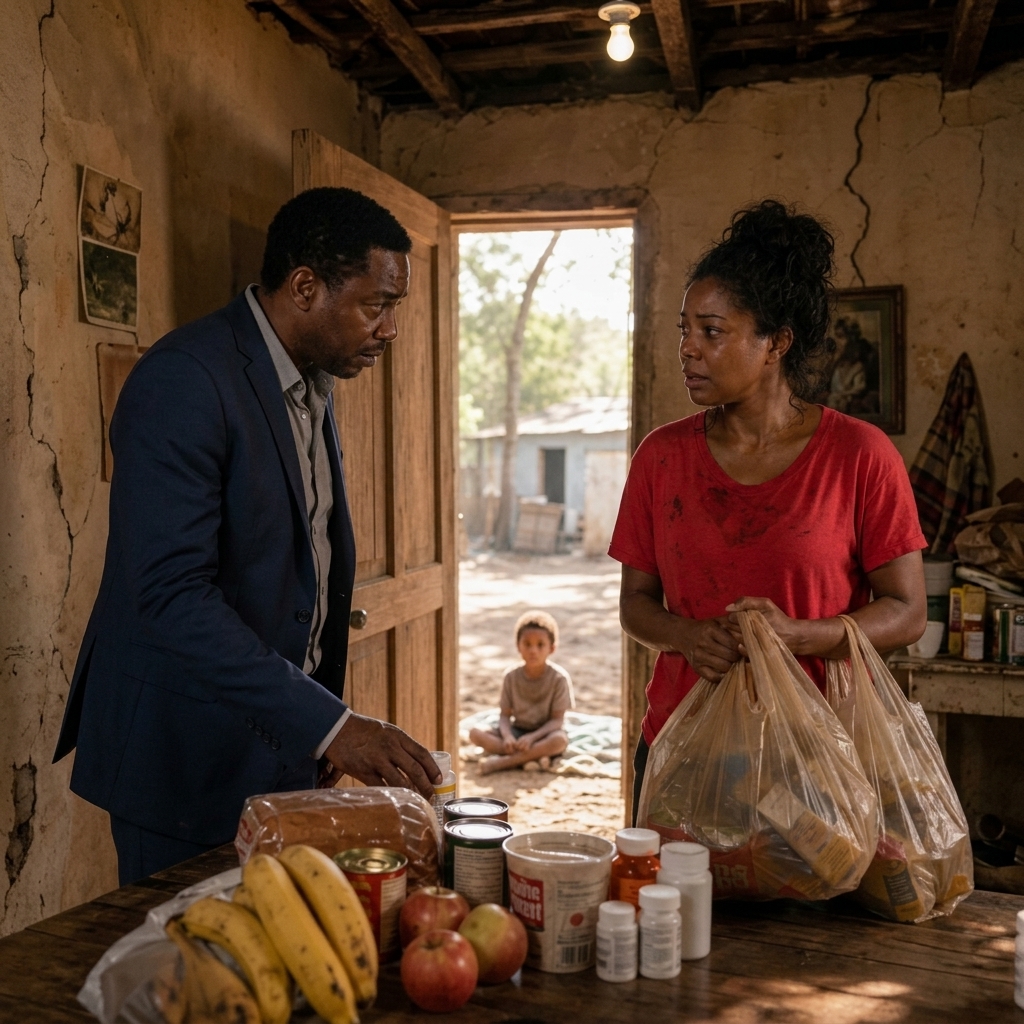
The room was so small that Emiliano could see nearly everything from the doorway. A narrow counter held a kettle, two chipped mugs, and a few plates. An old refrigerator hummed in the corner, while a small table stood beneath a window covered by faded curtains. There was no expensive furniture, no television large enough to fill a wall, and no sign of the luxurious lifestyle he had always associated with people who worked in his mansion. Rosa had spread a clean cloth over the table. Beside it sat a little boy of about eight years old, thin and pale, with dark hair falling across his forehead. His name, Emiliano would soon learn, was Mateo. The child was carefully arranging several small objects: a box of colored pencils, a packet of inexpensive biscuits, a worn storybook, and a collection of folded papers. Rosa took something else from the plastic bag—a small bottle of medicine and a sealed packet of children’s vitamins. “These should last us a few days,” she told him, trying to sound cheerful. Mateo smiled faintly. “Then I can go to school tomorrow?” Rosa hesitated before answering. “We will see how you feel in the morning.” Emiliano remained silent. His anger had not disappeared completely, but confusion was beginning to replace it. If Rosa had stolen the diamond ring, why was there no jewelry? Why was she arranging medicine and food on a table that appeared to have little else? He stepped forward, and the sound of his shoes against the concrete floor made Rosa turn abruptly. Her face lost its color. “Señor Emiliano?” she whispered. Mateo looked up in alarm. Rosa immediately moved closer to her son, as though instinct had taken over before she could think. “What are you doing here?” Emiliano demanded. “I followed you.” Rosa’s eyes widened. “You followed me?” “Your fiancée’s ring is missing. I saw you carrying that bag, and I want to know what you took from my house.” Rosa stared at him, then slowly looked down at the table. For a moment, she appeared too exhausted to defend herself. “I took nothing that belonged to you,” she answered. “I would never steal from anyone.” Emiliano pointed toward the bag. “Then explain why you were hiding it.” Rosa took a breath. She told him that the bag contained food she had purchased herself, a few inexpensive supplies, and a collection of old papers she had been keeping for years. She had brought the medicine from a pharmacy and the biscuits from a neighborhood shop. Nothing was stolen. “You could have told me,” he said, although he realized he had never given her much reason to believe he would listen. “Would you have believed me?” she asked. The question struck him more sharply than he expected. Before he could answer, Mateo reached toward a folded piece of paper near the edge of the table. “Mamá, is this the picture you said I could keep?” Rosa quickly turned toward him. “Not that one, sweetheart.” But the boy had already opened it. It was an old photograph, its edges worn and its colors fading. A young woman stood beside a little boy in front of a modest garden. The woman had dark hair, a warm smile, and eyes that seemed familiar to Emiliano. He moved closer. The child in the photograph was unmistakably him. He recognized the small scar near his eyebrow, the crooked collar of his shirt, and the toy airplane he had carried everywhere during his childhood. The woman beside him was his mother, Isabel Vargas, who had died when he was fourteen. Emiliano stared at the picture as if the room had tilted around him. “Where did you get that?” he asked. Rosa’s expression changed. She looked at Mateo, then at Emiliano, and finally at the photograph in his hands. “Your mother gave it to me many years ago,” she explained. Emiliano shook his head. “You knew my mother?” Rosa nodded slowly. “I worked for your family before you became a successful businessman. I helped care for your mother during the last year of her life, when she was ill. She treated me with kindness when I had very little, and she always said that a person’s worth was never measured by the size of their house.” Emiliano felt his throat tighten. He remembered those words. His mother had repeated them whenever he came home from school boasting about expensive toys or mocking children whose parents could not afford the latest clothes. After her death, he had buried himself in work and ambition, gradually forgetting the lessons she had tried to teach him. “Why have you kept this photograph?” he asked. Rosa gently folded her hands. “Because your mother mattered to me. She helped me when I was struggling, and I wanted to remember her kindness.” Then she opened a small envelope beside the photograph. Inside were several handwritten pages, carefully protected in transparent sleeves. Emiliano recognized his mother’s handwriting immediately. His breath caught. “Those are hers,” he whispered. Rosa nodded. “She asked me to keep them safe.” He looked at the table again. Beneath the letters lay a child’s drawing of a large house, a woman holding a little boy’s hand, and a small inscription in uneven handwriting: A home is where people care for each other. Suddenly, Emiliano understood that he had entered this modest kitchen expecting to expose a thief, only to find a piece of his own forgotten childhood. Yet one question remained unanswered. Why had Rosa brought the letters and photographs out today, of all days? And what exactly had his mother written in the final letter, the one Rosa had kept separate from the others?
Part 3: The Letter His Mother Never Wanted Him to Forget

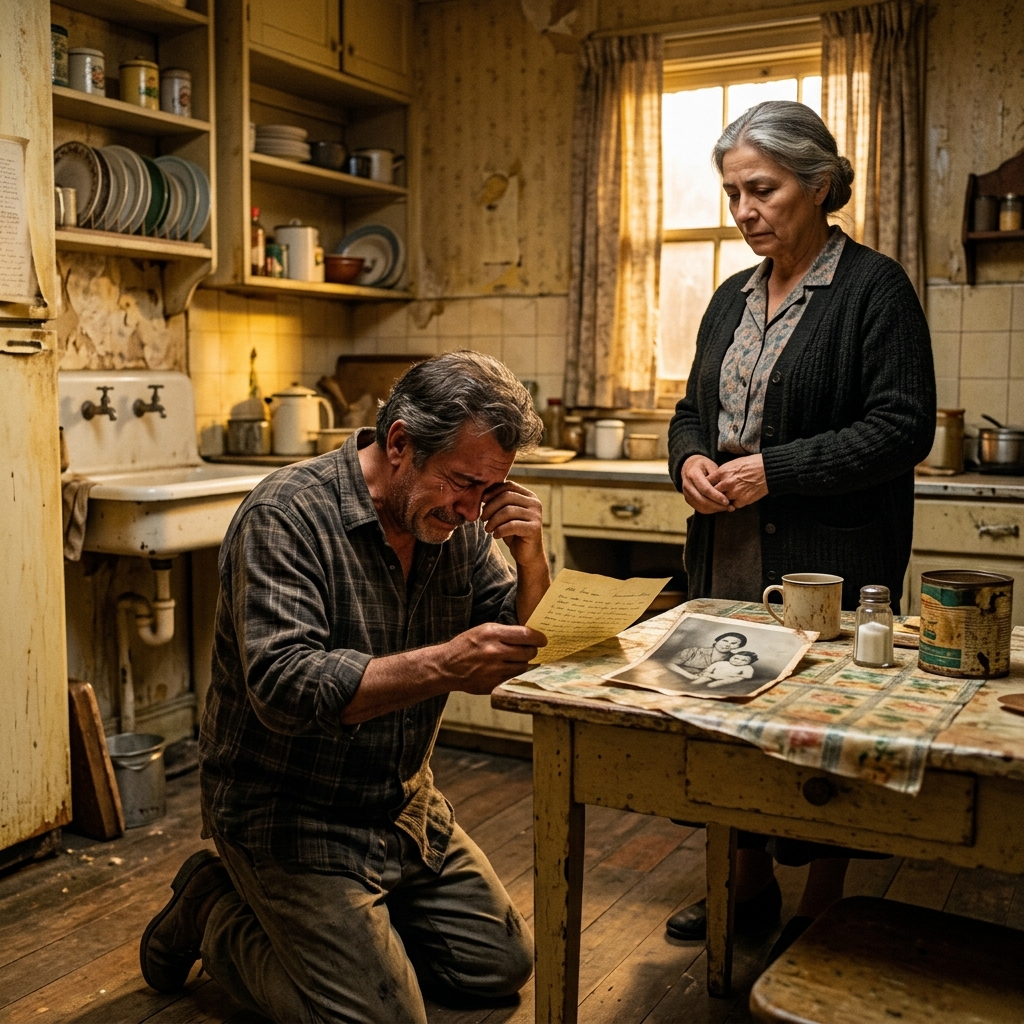
Rosa sat down slowly, as if the memories had become heavier than the years she had carried them. Mateo watched the adults in silence, sensing that the photograph had opened a door to something important. Emiliano stood beside the table, unable to look away from the handwriting he had not seen since his mother’s funeral. “Please tell me everything,” he said. His voice had lost the sharpness he usually used to command people. Rosa explained that she had worked in the Vargas household long before Emiliano inherited his first business interest. Isabel had often spoken about her son, worrying that the privileges surrounding him might teach him to confuse money with happiness. She loved him deeply, but she had also seen how easily he became impatient with people who could not give him what he wanted. “Your mother never wanted you to feel ashamed of being wealthy,” Rosa said. “She wanted you to understand that wealth gave you choices, and that those choices revealed your character.” Emiliano lowered his eyes. Rosa continued, explaining that Isabel had helped her during a difficult period when Mateo’s father had abandoned the family and Rosa was struggling to pay for basic necessities. Isabel had offered practical assistance without making Rosa feel indebted or inferior. She had helped her find affordable medical care, encouraged her to continue working, and insisted that Rosa’s son deserved the same opportunity to learn and dream as any other child. When Isabel became seriously ill, she gave Rosa a small collection of letters and photographs. She asked her to keep them safe, explaining that they contained memories she hoped Emiliano would one day understand. Rosa had planned to return the letters when he was older, but after Isabel died, the household changed. Emiliano’s relatives took charge of the estate, and Rosa eventually left the family’s service. Years passed. She found work elsewhere, raised Mateo, and preserved the letters in a sealed envelope. She had never attempted to contact Emiliano because she believed he had moved on and because she did not want to use his mother’s memory to ask for favors. “Then why bring them out today?” Emiliano asked. Rosa glanced toward her son. Mateo had been struggling with a serious medical condition that required regular appointments and medication. The family had recently faced unexpected expenses, and Rosa had been sorting through her belongings to decide what she could sell or give away. She had taken the old letters from their storage box because she wanted to read them to Mateo. She hoped the stories of Isabel’s kindness would help him understand that difficult circumstances did not make a person less valuable. The plastic bag contained those papers along with medicine and groceries. There was no stolen jewelry. There had never been any. Emiliano felt the weight of his assumptions settle over him. He had seen a tired woman carrying a bag and immediately imagined dishonesty. He had not considered the possibility that she was simply trying to care for her child. He looked at Mateo, who was now tracing the outline of the old photograph with one finger. “You have been keeping all this safe for years,” Emiliano murmured. “Why didn’t you ever tell me?” Rosa gave him a sad smile. “Because you never asked about my life, señor. You knew the rooms I cleaned and the hours I worked. You never knew the person who went home afterward.” Her words left him without an answer. Then she reached for the separate envelope. “There is one more letter,” she said. “Your mother asked me to give it to you if I ever believed you had forgotten what she wanted you to learn.” Emiliano’s hands trembled as he accepted it. The paper had yellowed with age, but the envelope was still sealed. His name was written across the front in his mother’s unmistakable script. He opened it carefully and unfolded the page. The letter began with a simple greeting, then described a day when he had been a child and had come home upset because a classmate had laughed at his old shoes. Isabel had comforted him, but she had also asked him to imagine how it felt to be the child who could not afford new shoes at all. She wrote that kindness was not a weakness and that a person who needed help should never be treated as though they had failed. Near the end, she had written: My son, if you ever become a man with more money than you know how to spend, I hope you will remember that the people who serve you are not beneath you. They carry hopes, disappointments, responsibilities, and love just as you do. Never let the size of your home make your heart smaller. Emiliano could no longer hold back his tears. He sank to his knees beside the little kitchen table, pressing the letter against his chest. For years, he had told himself that his mother would have been proud of his success. He had measured that success in properties, investments, and public recognition. Yet here, in a home far smaller than any room in his mansion, he was discovering that he had neglected the lesson she most wanted him to remember. Rosa stood quietly, uncertain whether she should comfort him or give him space. Mateo slipped from his chair and brought Emiliano a clean paper napkin. “You can use this,” the boy said innocently. The gesture broke what remained of Emiliano’s composure. He accepted the napkin with shaking hands. “Thank you, Mateo,” he whispered. Then he looked at Rosa. “I’m sorry. I accused you without proof. I followed you here because I thought the worst of you, and I never stopped to ask what was really happening.” Rosa did not immediately forgive him. She had spent years working hard, protecting her son, and trying to preserve her dignity in a world that often judged people by their circumstances. An apology mattered, but it could not erase the humiliation she had experienced that afternoon. “I appreciate your words,” she replied carefully. “But I need you to understand that being poor does not make someone suspicious, and working in your home does not mean you have no life of your own.” Emiliano nodded, accepting the truth without argument. Before he could respond, his phone began vibrating repeatedly. Valeria was calling. He had forgotten to tell her where he had gone, and she had sent a series of increasingly angry messages. When he finally answered, she demanded to know whether he had found the ring and whether Rosa had confessed. Emiliano looked toward the table, where the photograph, the letters, and Mateo’s drawing lay beneath the warm kitchen light. “I found something much more important than a ring,” he replied. “And I need you to listen to me carefully, because everything is about to change.”
Part 4: The Millionaire Who Finally Learned What Wealth Meant
Emiliano returned to his mansion that evening with the old letter safely tucked inside his jacket. For the first time in years, the enormous house felt less like a symbol of success and more like a place filled with things he had mistaken for happiness. The marble floors shone beneath the lights, the expensive paintings hung perfectly straight, and the dining table was set for a dinner that nobody seemed interested in eating. Valeria waited in the living room, furious that he had disappeared without explanation. “Well?” she demanded. “Did you find the ring? Did Rosa admit what she did?” Emiliano looked at her for a long moment. He asked whether she had checked every drawer, handbag, and piece of clothing before accusing the housekeeper. Valeria scoffed. “Why are you defending her? You know what people like that are capable of.” The words landed heavily. Emiliano had spent the afternoon listening to a woman he had treated as invisible explain the meaning of dignity. Now he was hearing his fiancée dismiss an entire person because of her economic circumstances. “You don’t know what Rosa is capable of,” he replied. “Neither did I. That was the problem. We accused her without evidence.” Valeria insisted that the ring had been missing and that someone had to be responsible. Emiliano agreed that the disappearance needed an explanation, but he refused to accept suspicion as proof. They searched the bedroom together, checking the dressing table, the bedside drawers, and the small compartments inside Valeria’s jewelry box. Finally, Valeria opened a velvet travel case she had not used for weeks. Inside, beneath a folded scarf, lay the diamond ring. She froze. Emiliano stared at it. For several seconds, neither spoke. “I must have put it there,” Valeria said at last. “I was packing jewelry for our weekend trip.” She tried to laugh, as though the discovery were an amusing inconvenience. “Well, at least we found it.” But Emiliano could not laugh. The ring had never been proof of Rosa’s guilt. It had simply been missing, and Valeria had chosen the easiest person to blame. “You accused her of theft,” he said. “You demanded that I have her arrested. I followed her home believing she had done something terrible, and I treated her as if she were guilty before I knew anything.” Valeria crossed her arms. “You’re making this much bigger than it needs to be. We found the ring. The problem is solved.” “No,” Emiliano answered. “We found the ring. That doesn’t undo what we did to her.” He explained what he had learned about Rosa, her son, and his mother’s letters. He told Valeria that the woman they had dismissed as a servant had preserved a part of his childhood that he himself had forgotten. Valeria listened impatiently, eventually declaring that he was becoming sentimental over a housekeeper. Emiliano looked at her and realized that their disagreement was about more than one missing ring. It was about the kind of people they wanted to be and the values they were willing to defend. “I don’t want to build a life in which someone can be humiliated simply because they have less money than we do,” he said. Valeria accused him of changing, and for once, he accepted the accusation as a compliment. Their engagement ended several weeks later. It was not a decision Emiliano made lightly, but he understood that a future built on contempt and appearances would never become the family he wanted. He did not announce the breakup as a grand moral victory, nor did he use Rosa’s story to shame Valeria publicly. He simply acknowledged that their values no longer aligned and took responsibility for his part in the relationship. His next decision concerned Rosa. He contacted her and asked whether she would be willing to meet him, making it clear that she was under no obligation to return to work or accept anything from him. Rosa agreed to a conversation but insisted that it take place on her terms. When they met, Emiliano offered a sincere apology and acknowledged that his behavior had been unfair. He also asked whether she would consider receiving compensation for the distress caused by his accusation and whether there was any practical assistance she and Mateo needed. Rosa listened before answering. She explained that she wanted stable employment, respect for her privacy, and access to reliable resources for her son’s care—not charity that would make her feel indebted or obligated to him. Emiliano accepted those conditions. With Rosa’s permission, he arranged for her to receive the wages she was owed, provided a written reference for future employment, and offered financial assistance toward Mateo’s medical expenses through a transparent arrangement that Rosa could decline or modify. He also hired a qualified adviser to help her identify appropriate medical and community resources, without demanding access to private information about her family. The assistance was not a substitute for accountability, and Emiliano did not expect it to erase what had happened. He began making changes in his own business as well. He reviewed employment practices across his household and companies, introduced clearer procedures for handling complaints, and instructed managers that allegations against employees must be investigated fairly rather than treated as proven because of someone’s position or income. He began learning the names of the people who worked around him and asking about their lives without assuming they owed him personal details. Some people were skeptical of the change. Others believed it was a temporary reaction to an emotional experience. Emiliano knew that a few good decisions could not transform his character overnight. What mattered was whether he continued behaving differently when nobody was watching. Months later, he returned to Rosa’s neighborhood at her invitation. Mateo had improved enough to spend more time outside, and he was preparing a small school project about people who had made a difference in his life. On the kitchen table lay the familiar photograph of Isabel, along with a new picture Mateo had drawn. It showed three people standing beside a little house, with a tree growing in the yard and a bright sun overhead. Emiliano studied the drawing and smiled. “Is that your family?” he asked. Mateo nodded. “It’s people who helped each other.” Rosa brought tea to the table, and for the first time, Emiliano felt comfortable sitting in the modest room without comparing it to his mansion. They talked about Isabel, remembering her humor, her patience, and her belief that kindness should never depend on a person’s status. Before Emiliano left, Rosa handed him a copy of the letter he had read that terrible afternoon. She wanted him to keep it, she said, not as a reminder of his shame, but as a reminder of what he could choose to become. He thanked her and promised to honor that wish. On the drive home, he thought about the day he had followed Rosa because he was convinced she had stolen something valuable. He had expected to catch a criminal, recover a diamond, and restore his pride. Instead, he had discovered how quickly he could mistake poverty for guilt and how easily wealth could shield him from the lives of other people. The ring had been found in a jewelry case, but the greater discovery had taken place around a small kitchen table, beneath a weak yellow light, where a woman had preserved the memory of his mother and a child had offered a stranger a paper napkin. Emiliano never forgot that afternoon. It changed the way he treated his employees, the way he understood his mother’s legacy, and the way he measured the success of his life. He continued building companies and investing in property, but he no longer believed that money alone could tell him whether he had become a good man. He learned that fairness begins before the evidence is complete, that apologies mean little without changed behavior, and that a person’s dignity does not depend on the size of their home. Most importantly, he learned that the people we overlook may be carrying stories that could change our lives if we were willing to listen. Sometimes, the most valuable thing a wealthy person can discover is not another opportunity to make money. It is the truth about the person they have become—and the chance to become someone better.
