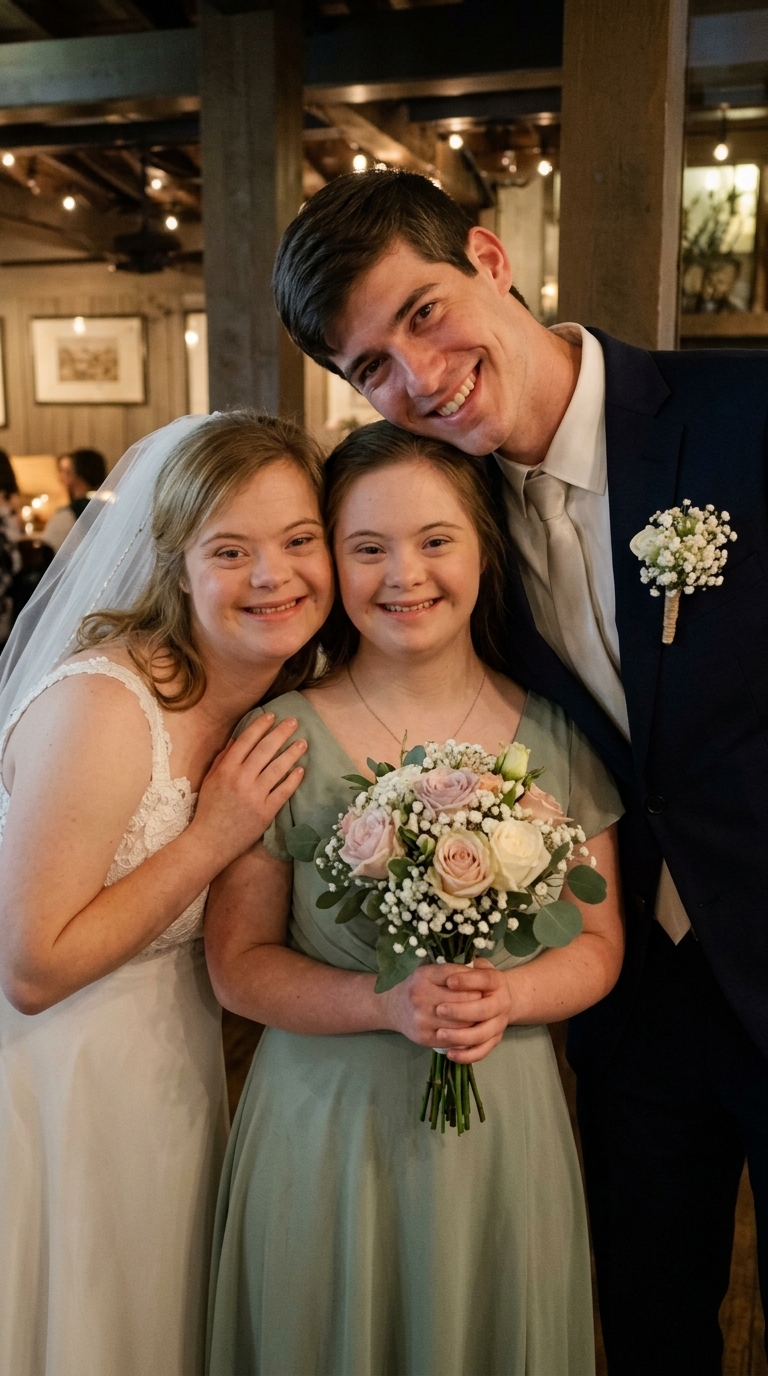
Part 1: The Promise That Followed Us Into Adulthood
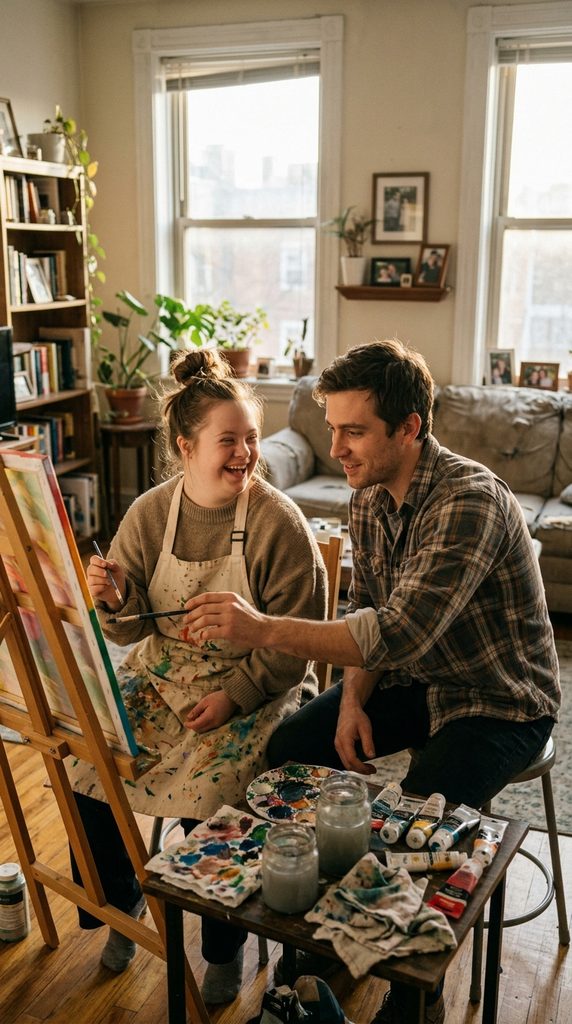
I was seven years old when I first realized that the world could be cruel to someone simply because they were different. My little sister, Rosie, was six, with bright eyes, a tumble of brown curls, and a smile that appeared whenever someone treated her with genuine kindness. She had Down syndrome, and although she was still too young to understand why certain children avoided her or whispered when she walked past, she understood the sting of being laughed at. I remember one afternoon on the school playground when a group of children imitated the way she spoke. Rosie stood frozen near the swings, clutching the straps of her backpack, her eyes filling with tears she was desperately trying not to shed. I ran toward them, furious and frightened, ready to fight children twice my size if that was what it took to make them stop. Before I could reach my sister, however, my best friend, Ben, stepped between Rosie and the laughing children. He was a quiet boy with untidy hair, scraped knees, and a habit of looking directly at people when he spoke. He didn’t shout or threaten anyone. He simply told them their behavior was ugly and that they should be ashamed of themselves.
Then he turned to Rosie, took her hand, and asked whether she wanted to join him for kickball. When she hesitated, he patiently explained the rules again, even though she had heard them dozens of times. That afternoon, Ben treated my sister as if she belonged exactly where she was. From then on, he became a regular presence in our home. He rode his bicycle to our house after school, helped Rosie with puzzles, watched her favorite cartoons, and listened to her stories even when she repeated the same details several times. While other children grew impatient, Ben seemed to discover something endlessly interesting in the way she viewed the world.
He never made a show of his kindness, and that was what made it feel real. To me, he was the brother I had never been given, the friend who understood my family without needing everything explained. Our parents appreciated him, although they rarely expressed affection openly. My mother worried constantly about Rosie’s future, while my father believed that planning carefully was more important than talking about feelings. Ben, on the other hand, never treated the future as something frightening. One afternoon in fourth grade, he crouched beside Rosie in our garden and told her that when they were older, he would take her to the high school prom. Rosie clapped her hands, delighted by the idea, and immediately demanded that I promise to attend too. I laughed because we were children and the prom seemed impossibly far away, but Ben looked at her with complete seriousness. He told her that a promise was a promise. I remembered those words for years, never imagining how profoundly they would shape our lives.
As we grew older, Ben’s visits became part of the rhythm of our household. Rosie would wait by the front window around the time he usually arrived, watching the street for the familiar movement of his bicycle. When he appeared, she would rush to the door and announce whatever important news she had been saving for him. Sometimes it was a new song she had learned; sometimes it was a drawing she wanted him to admire; sometimes it was simply the fact that she had chosen a blue shirt because blue was his favorite color. He remembered the little things she told him. If she mentioned wanting to see a particular movie, he would eventually show up with tickets. If she had a difficult day at school, he would sit beside her until she felt ready to talk. I loved him for all of it, and somewhere between childhood and adolescence, that love quietly changed into something I was too embarrassed to name. By the time I was seventeen, I had begun imagining a future in which Ben and I lived in a small house, visited our parents on Sundays, and remained close enough to Rosie that she would never feel abandoned. I convinced myself that his long conversations with me, his teasing smiles, and the way he sometimes lingered on our porch meant that he imagined the same future. I never confessed my feelings.
I was afraid that speaking them aloud would destroy the comfortable life we had built together, and I assumed that time would eventually bring us the answer I wanted. Then, when I was twenty-two, Ben arrived at our house on a Sunday afternoon carrying a small velvet box. My heart leaped before I had time to remind myself that I had no reason to hope. I imagined a ring, a proposal, and a future I had privately rehearsed a hundred times. Instead, he asked whether Rosie was in the garden. I followed him to the kitchen window and watched as he approached my sister among the tomato plants she had helped our mother grow. He knelt in front of her and opened the box. Rosie covered her mouth with both hands, then nodded so enthusiastically that her curls bounced around her face. I couldn’t hear every word, but I didn’t need to.
Ben was asking my sister to marry him. That night, I cried into my pillow, ashamed of the jealousy twisting inside me. I told myself he must have a reason beyond love, because admitting that he might genuinely want a life with Rosie felt unbearable. Yet the following morning, I helped her choose wedding colors, listened as she described the dress she wanted, and promised to be her maid of honor. She hugged me so tightly that I could barely breathe. I hugged her back and tried to bury my heartbreak beneath her happiness. Their wedding was small and intimate. Ben wore a gray suit, Rosie carried a simple bouquet, and our parents smiled as they watched her walk toward him. When Ben saw her, tears gathered in his eyes. My father congratulated him afterward and said he had made a good choice. I stood beside my sister as she slipped on her wedding ring, wondering whether I had ever truly understood my best friend. I didn’t know then that the most painful question about their marriage would not be whether he loved her, but why my parents had been so willing to let it happen.
Part 2: The Marriage I Thought I Understood
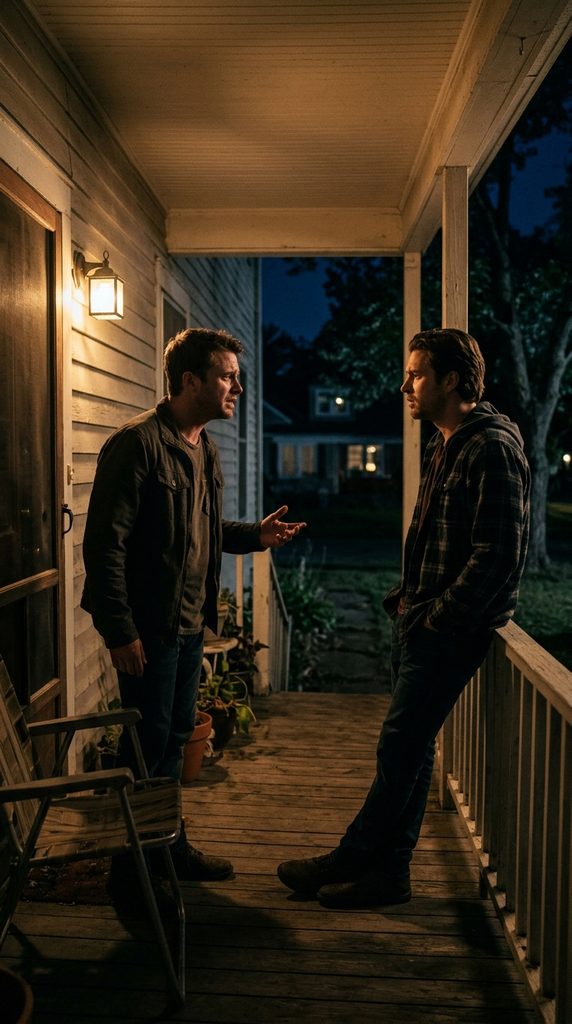
After the wedding, Rosie moved with Ben into a small yellow house at the edge of town. It had a narrow porch, white curtains, and a kitchen window that looked out over a patch of garden where Ben planted tomatoes because Rosie loved helping them grow. Their life wasn’t glamorous, but it seemed peaceful. Rosie called me nearly every morning, sometimes to tell me what she planned to wear, sometimes to ask what she should cook for dinner, and sometimes because she simply wanted to hear my voice. Ben was patient with her routines, and he encouraged her to make decisions rather than assuming he should make them for her. When Rosie wanted to learn a new recipe, he stood beside her and followed her instructions, even when the kitchen became a disaster. When she grew frustrated with a task, he never rushed to finish it for her unless she asked. I watched their marriage from a distance, gradually rebuilding my own life. I met a kind man named Daniel, who made me laugh and never asked me to pretend I wasn’t hurt when I was. We dated for a while, and although I eventually accepted that Ben would never be mine, a small, stubborn part of me continued to wonder what I had missed.
I told myself that jealousy was an ordinary human feeling, not a moral failure, and that the important thing was how I treated my sister. I showed up for birthdays, helped decorate their house at Christmas, and celebrated every small milestone Rosie achieved. Still, whenever I saw Ben tuck a blanket around her shoulders or look at her with that familiar tenderness, I sometimes felt an old ache return. Then, three years into their marriage, Rosie called me with news so extraordinary that I dropped my phone onto the carpet. She was pregnant—with twins. She spoke in a breathless whisper, as though saying the words too loudly might cause the miracle to disappear. I laughed and cried at the same time, asking whether she was serious, whether the doctor was certain, whether she had told Ben yet. She laughed at my questions and said Ben had cried when they first heard the news. Rosie had always wanted a family, and the thought of becoming a mother filled her with an excitement that made every conversation brighter.
My parents reacted with a mixture of surprise and concern, asking questions about medical care, finances, and how the couple would manage the demands of raising two babies. I shared some of those concerns, but I also believed that Rosie deserved the chance to build the life she wanted. She and Ben began preparing a nursery, choosing tiny blankets and arranging two cribs beside the window. Ben sent me photographs of the room, proud of every detail, from the hand-painted stars on the wall to the shelf where Rosie had placed her favorite childhood books. I visited whenever I could, and I saw how carefully they planned for the twins. Ben attended appointments, learned what he could about caring for newborns, and listened when Rosie talked about the kind of mother she hoped to become. He never treated the pregnancy as something happening to him; he treated it as a journey they were taking together. For the first time, I stopped wondering whether their marriage was a mistake and began believing that perhaps my sister had found exactly the partner she needed. I should have recognized how much that belief mattered when the phone rang one night and changed everything.
Rosie was thirty-four weeks pregnant when she was rushed to the hospital. I drove there so quickly that I barely remembered the journey, my hands gripping the steering wheel while every frightening possibility crowded into my mind. Ben was already in the waiting room when I arrived. His face had lost its color, and he kept standing up, walking a few steps, and sitting down again as if his body couldn’t decide what to do with the fear. The hospital smelled of disinfectant and stale coffee. Beyond the double doors, medical staff moved with urgent purpose, while the clock above the reception desk seemed to tick louder with every passing minute. We had been told that Rosie was experiencing a serious complication and that the doctors were working to deliver the babies safely. I tried to reassure Ben, telling him that Rosie was strong and that the medical team was doing everything possible. The words sounded hollow even to me. He pressed his palms against his face and whispered that he had promised her they would bring their children home together. I sat beside him, remembering the boy who had once promised a little girl that he would take her to prom. Through all the years that followed, Ben had kept showing up for Rosie, and now he was powerless to do anything except wait. At last, a doctor emerged from the delivery area.
The expression on his face made my stomach drop before he spoke. The twins had been delivered and were receiving care, he explained, but Rosie had lost a dangerous amount of blood. The team had managed to stabilize her temporarily, yet her condition was deteriorating, and they were doing everything they could to save her. I reached for Ben’s arm. He looked as though he had been struck. Then, very quietly, he said, “I need to tell you something.” I thought he was about to confess a fear or ask me to help him make a decision about the babies. Instead, he led me away from the waiting room to a quiet alcove near the stairwell. He reached inside his jacket and removed a folded document. His hands shook so badly that the paper rustled between us. “Rosie made me promise that if something happened to her, I would finally tell you the truth,” he said. I stared at him, unable to understand why he was talking about secrets while my sister lay fighting for her life. Then he looked directly into my eyes and said, “You need to know why I really married her.” Every doubt I had buried after the wedding came rushing back. Before I could ask what he meant, he placed the document in my hands. I unfolded it, glanced at the letterhead, and felt the corridor tilt beneath my feet. The document carried my father’s law firm’s name. Beneath it were signatures I recognized immediately—my parents’ names, and Ben’s. And beside them was a payment schedule worth six figures.
Part 3: The Contract Behind the Wedding
For several seconds, I couldn’t make sense of what I was reading. The legal language seemed to blur, but the meaning was painfully clear: money was to be paid to Ben in connection with his marriage to Rosie. I looked at his signature, then at the names of my parents, searching for some explanation that would make the document less horrifying. “You took money to marry my sister?” I demanded. My voice echoed through the empty corridor. “You stood beside her at the altar and promised to love her, and all this time there was a contract?” Ben flinched as though I had slapped him. He tried to speak, but I cut him off. I accused him of using Rosie’s trust, of accepting a financial reward to take responsibility for someone my parents considered inconvenient, and of allowing all of us to believe his intentions were pure. My anger was tangled with grief, and beneath both was the terrible thought that I had been right all along.
Perhaps he hadn’t chosen Rosie because he loved her. Perhaps the marriage had been an arrangement, and the affection I had witnessed was merely part of the performance. Ben slid down the wall until he was sitting on the cold floor, his face wet with tears. When he finally spoke, his voice was almost too quiet to hear. “I never kept a dollar of that money,” he said. “Not one payment. Everything they sent went into an account for Rosie. It belongs to her, and it always has.” I shook my head, refusing to accept an explanation that sounded too convenient. If he hadn’t wanted the money, why had he signed the contract? Why had he kept it secret from me? Ben looked down at the paper in my hands and told me that the story began before the proposal. My parents had approached him when he was a young adult, worried about what would happen to Rosie as they grew older. Instead of discussing how the family could support her independence, they had begun looking for a way to transfer responsibility to someone else.
They had researched a residential facility called Willow Grove and considered placing Rosie there. The brochure described supervised living, structured activities, and professional assistance, but Ben said that the way my mother spoke about the place made it clear that the decision had little to do with what Rosie wanted. They had started referring to my sister as a burden, as though her need for support erased her personality, her ambitions, and her right to choose her future. My parents feared that I would spend my life caring for Rosie and that neither of us would have the freedom they imagined we deserved. Instead of asking me what I wanted or including Rosie in decisions about her own life, they decided they could settle the matter privately. They offered Ben a financial arrangement tied to marrying her and taking on a formal role in her care. I felt sick. I had spent years believing my parents were simply anxious about Rosie’s future. I had never imagined they would turn that anxiety into a secret agreement that treated my sister’s marriage as a transaction. “They were going to send her away without telling you,” Ben said. “Your mother told me you deserved a life of your own, and that they didn’t want Rosie to become your responsibility.” I stared at him, unable to reconcile those words with the family I thought I knew. I had never been asked whether I wanted to help my sister. Rosie had never been given the chance to discuss the plan. My parents had made their decision behind closed doors, convinced that they understood what was best for everyone. And Ben had been the only person who refused to accept that Rosie should be moved aside for the convenience of others.
“But why marry her?” I asked, my voice breaking. “Why not tell me what they were planning? Why not come to me?” Ben took a shaky breath. He explained that when my parents approached him, he had been horrified by the idea that Rosie might be sent away simply because the people closest to her had stopped seeing her as a whole person. He knew she wanted an ordinary adult life: a home of her own, meaningful work, friendships, and the possibility of becoming a wife and mother. He also knew that love alone would not erase the practical challenges she might face. He had asked questions, spoken with professionals, and thought carefully about whether he could genuinely offer her a stable partnership. He did not want to promise a life he couldn’t provide, and he did not believe marriage should be used as a shortcut around the support Rosie might need. Eventually, he agreed to the arrangement only after insisting that the money be kept for her benefit, separate from his own finances. But he told me that the contract was not the reason he married her.
He had loved Rosie for years—not as a child he wanted to protect forever, but as a person whose humor, determination, kindness, and companionship had become part of his life. He wanted to build a future with her, and the agreement gave him a way to ensure that she would have financial resources if her parents ever withdrew their support. “I know what that paper looks like,” he said. “I know how it sounds. But I couldn’t watch them send her somewhere she never chose while pretending that it was the only responsible option.” I wanted to believe him, yet the revelation hurt in ways I couldn’t immediately explain. I was furious with my parents, ashamed of my own assumptions, and devastated that Ben had kept such a monumental secret from me. When I asked whether Rosie knew, he nodded. About a year into their marriage, he had told her everything. He said she had cried—not because she felt tricked into marrying him, but because she was hurt that her parents had considered making decisions about her future without asking her.
Then she had surprised him. After sitting quietly with the truth, Rosie told him that she wanted to remain married to him, because she loved him and knew he loved her. She understood that the contract existed, but she refused to let it define their relationship. She asked him not to tell me because she feared I would confront our parents before she was ready, and she didn’t want the family to fracture while she was still finding her footing as an adult. Ben had respected her request, even when it became increasingly difficult to carry the secret. Now, with Rosie fighting for her life, she had asked him to tell me if she could not speak for herself. I looked back toward the delivery area, remembering the flowers he brought her for no special reason, the way he learned her favorite songs, and how he had helped her prepare for the twins. Those gestures had never looked like a performance. They had looked like love because they were love. I lowered the document and whispered that I had hated him for two minutes. He gave a broken laugh and said he would have hated himself for longer. Before either of us could say anything else, hurried footsteps sounded at the end of the corridor. A doctor was approaching. My heart began to pound again. I stood, clutching the contract, preparing myself for whatever news he carried. Then the elevator doors opened, and my parents stepped out, looking toward us with the same anxious expressions they had worn when they arrived at the hospital. I realized that the truth was no longer something I could quietly absorb and set aside. Before the night was over, I would have to decide whether protecting my family meant preserving its secrets—or finally telling the truth.
Part 4: The Truth That Changed Our Family Forever
The doctor stopped in front of us, and for one unbearable moment, none of us spoke. Then he told us that Rosie was stable. She had lost a significant amount of blood, but the medical team had managed to control the bleeding and was continuing to monitor her closely. The twins were breathing on their own and receiving care while the doctors watched for complications. I felt my knees weaken with relief. Ben covered his face and began to cry, his shoulders shaking with the kind of sob that comes only after someone has been holding terror inside for too long. I grabbed his sleeve and told him that Rosie had made it through the worst of the emergency, though we knew she would need time and careful medical attention. My mother stepped toward us with her arms open, apparently expecting that we would all collapse into a grateful family embrace.
Instead, I stepped back. I held up the contract and asked whether she wanted to explain it. Her expression changed instantly. My father looked from the paper to Ben, then to me, and I saw recognition settle across his face. My mother lowered her voice and insisted that the hospital corridor was not the place to discuss family business. I told her that the place to discuss it had been years earlier, before she and my father decided that Rosie was a burden whose future could be arranged without her consent. She tried to interrupt, but I continued. I asked how they could have considered sending my sister to Willow Grove without speaking honestly with her, and how they could have offered money in connection with her marriage while allowing the rest of us to believe nothing unusual had happened. My father became defensive.
He said they had been trying to plan responsibly, that Rosie would eventually need support, and that they had worried about what would happen when they were no longer able to help her. Those concerns were not imaginary, and I could understand that planning for the future mattered. But concern did not justify secrecy, coercion, or treating Rosie as though her life belonged to everyone except herself. “You could have talked to us,” I said. “You could have asked Rosie what she wanted. You could have helped her make a plan that respected her independence. Instead, you decided that the easiest solution was to make her someone else’s responsibility.” My mother pointed toward Ben and said he had accepted the arrangement too, as though his signature made every choice equivalent.
I looked at the contract again. Ben had signed it, and I could not pretend that secrecy was harmless simply because his motives were loving. He had kept the truth from me for years, and I would need time to understand that decision. But he had placed the money in Rosie’s name, honored her wishes, and built a life with her that reflected her hopes rather than diminishing them. My parents, meanwhile, had created a plan that excluded the very person whose future they claimed to be protecting. “Ben signed a document to make sure Rosie had a home and financial security,” I told them. “You signed it because you wanted her future settled without having to face her as an equal.
Those are not the same thing.” A few people in the waiting area had begun to listen. My mother glanced around and asked me to lower my voice. I refused. I was not trying to humiliate her; I was trying to stop her from turning the truth into another secret that everyone would be expected to carry. At last, my father fell silent, and my mother looked away. They left for the elevator without another word. As the doors closed, I felt no triumph, only an exhausting mixture of anger, sorrow, and relief. Ben stood beside me, uncertain whether I would ever forgive him for keeping the truth from me. I reached for his hand. I told him I was still hurt, but that I understood why he had made the choices he did. We had almost lost Rosie that night. Whatever happened next, I did not want us to waste the chance we had been given by turning against each other over a truth that should never have been hidden. A nurse appeared a few minutes later and told us Rosie was awake and asking for both of us. Ben and I walked toward her room together.
Rosie lay in the hospital bed looking exhausted, her face pale beneath the soft light, but her eyes brightened when she saw us. Two tiny babies rested in nearby bassinets, their small chests rising and falling with each breath. I hurried to her bedside and held her hand carefully, afraid that even the gentlest movement might hurt her. She squeezed my fingers and asked whether the babies were all right. I told her they were receiving care and that the doctors were watching them closely. Ben leaned down and kissed her forehead, whispering that he was there and wasn’t going anywhere. Rosie looked from him to me, and I could tell she understood that the conversation she had feared was finally over.
I told her that I knew about the agreement and that I was sorry she had ever been made to feel that her future was something other people could bargain over. She began to cry, and I cried with her. I promised that from then on, decisions affecting her life would be made with her, not behind her back. She listened, then told me that she had always known Ben loved her, even after he explained the circumstances surrounding their marriage. She had chosen him because he made her feel respected, safe, and free to become more of herself. The money had mattered because it offered security, but it had never been the heart of their relationship. Their marriage was not a story about someone rescuing a helpless woman. It was a partnership in which two adults had chosen each other, faced difficult questions, and tried to build a future on their own terms.
Over the following weeks, Rosie recovered slowly, while the twins grew stronger under the care of the medical team. Our family had to confront practical questions about money, caregiving, and long-term planning that we should have addressed years earlier. An attorney reviewed the agreement and helped clarify the rights and responsibilities involved. My parents eventually stepped away from their roles in managing Rosie’s family trust, and a different relative took over those duties with clearer oversight. The money set aside for Rosie remained intended for her future, and we worked to ensure that decisions about it would be transparent. My relationship with my parents did not heal overnight. I needed time to process their choices, and they needed to acknowledge that good intentions did not excuse the way they had treated my sister.
I told them that reconciliation would require honesty and a willingness to listen to Rosie rather than deciding what was best for her. Ben and I also had difficult conversations about the years he had kept the secret. I could understand why he had honored Rosie’s request, but I explained how deeply the silence had damaged my trust. He listened without making excuses. Slowly, we began rebuilding our friendship on a more honest foundation. A few months later, we gathered to celebrate the twins’ dedication. Rosie held one baby while Ben cradled the other, and she smiled with a joy that seemed to fill the entire room. I watched them surrounded by people who had come to celebrate their growing family, and I thought about the promise Ben had made in our garden when we were children. Back then, I had believed that keeping Rosie safe meant standing in front of her whenever the world was cruel.
I understood now that love required something more: standing beside her while she made her own choices, even when those choices were complicated or frightening. Ben had not been perfect, and our family had not been free of mistakes. But the crisis had forced us to face a truth that could no longer be ignored: Rosie had never needed people to decide whether she deserved a full life. She needed people who would respect her right to live one. As I watched my sister laugh softly at something Ben whispered, I finally let go of the future I had once imagined for myself and my best friend. The love I had wanted from him had never been mine, but the friendship we shared was still real, and my sister’s happiness was not a loss. It was something I could celebrate without resentment. That day, I learned that family is not protected by silence, that devotion cannot be measured by a contract, and that the strongest promises are the ones we keep while allowing the people we love to remain fully themselves. Ben had promised Rosie a place beside him when they were children. Years later, through fear, conflict, and painful revelations, he had honored that promise. And in doing so, he taught me that the deepest kind of love does not ask someone to become less of who they are. It makes room for them to become more.
