Part 1: The Woman Who Took Out the Trash Before Sunrise
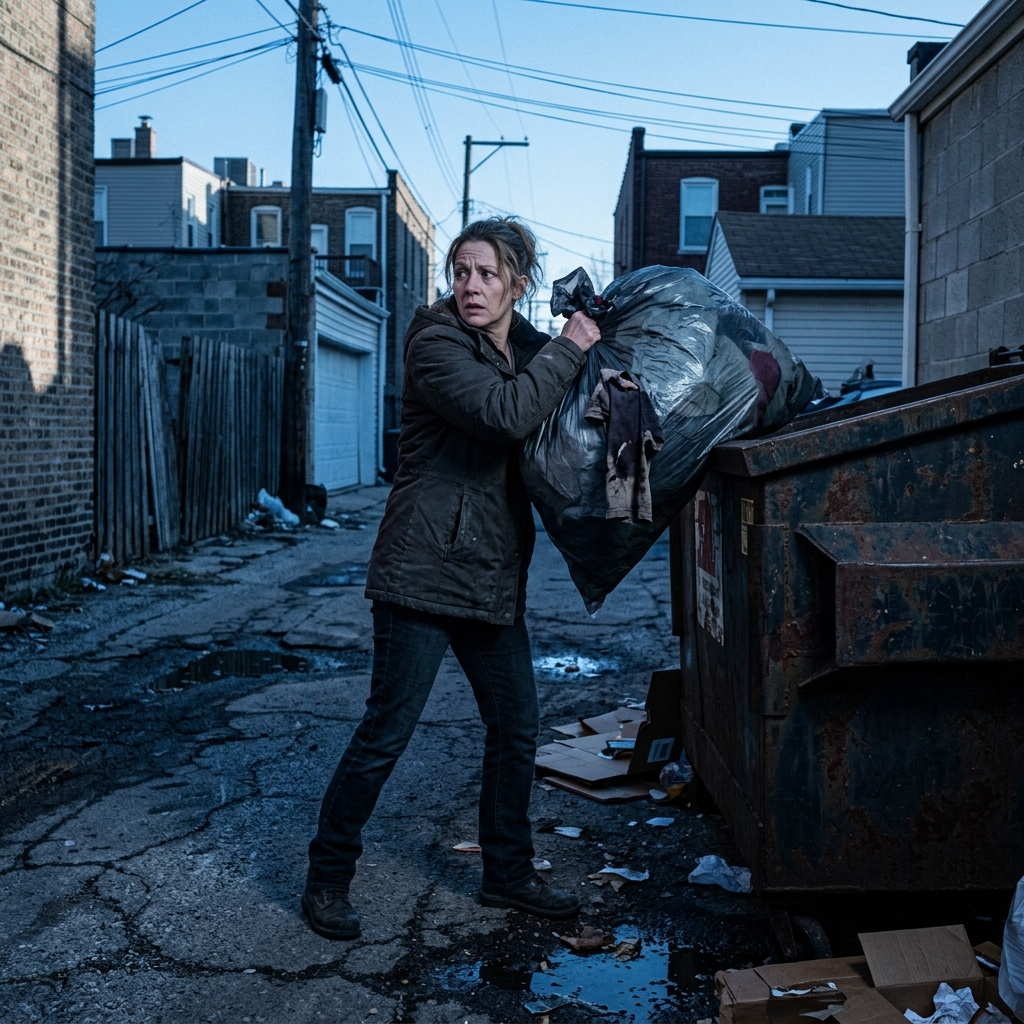
Every morning, precisely at seven o’clock, my neighbor Barbara appeared outside her beautiful house carrying another pair of heavy black garbage bags. At first, I barely noticed her routine. In our quiet suburban neighborhood, people developed their own habits, and Barbara’s seemed harmless enough. She wore a fluffy pink bathrobe, slipped her feet into white house slippers, and dragged the bags toward the curb just before the sanitation truck arrived. She was always polite when we crossed paths, smiling warmly and asking about my wife, the weather, or whether I had finally repaired the loose fence between our properties. Her lawn was immaculate, her flower beds were carefully arranged, and not a single curtain in her house ever seemed out of place. If someone had asked me to describe the perfect suburban neighbor, Barbara would have been an obvious choice. Yet there was something unusual about the garbage bags. They were too heavy for ordinary household waste, and she struggled with them in a way that suggested their contents were dense and awkwardly shaped. Sometimes she dragged one bag across the driveway, stopping every few feet to catch her breath. Other mornings, she carried two at once, her jaw clenched and her eyes fixed on the pavement. I wondered whether she was clearing out an attic or renovating a room, but no contractors ever arrived, and I never heard the noise of construction. When I asked whether she was doing a major cleanout, she laughed lightly and said that she had accumulated too many things over the years. “You’d be amazed how much junk a person can collect,” she told me one morning. “Eventually, you have to make room for something new.” Her answer sounded ordinary, but the way she said it stayed with me. Barbara had lived in the house for years with her husband, Arthur, a wealthy businessman whose expensive car used to occupy the garage. I remembered seeing him at neighborhood gatherings, dressed in tailored suits and speaking confidently about investments, travel, and the properties he owned. He was a tall, dark-haired man who appeared accustomed to being listened to. Although he and Barbara rarely displayed affection in public, they had always seemed like an established couple whose lives were settled. Then, without any announcement, Arthur disappeared. His car stopped appearing in the driveway, his name vanished from the neighborhood conversations, and Barbara began attending gatherings alone. When someone asked where he was, she explained that they had separated and that he had decided to leave. She spoke calmly, almost casually, as if the end of a long marriage were no more complicated than changing a cable provider. Most people accepted the explanation. Adults separated, houses changed hands, and private relationships were not our business. Still, I found it strange that no one ever saw Arthur again. There were no moving boxes, no farewell gathering, and no public announcement about a divorce. Barbara continued to live in the house as though nothing had changed, maintaining her garden and greeting the mail carrier with the same familiar smile. But the garbage bags kept coming, one after another, every morning. Eventually, curiosity began to overcome my good manners. I started noticing that the bags were not filled with ordinary rubbish. They had the unmistakable outlines of clothing, and sometimes a rigid corner pressed against the plastic as if a picture frame or a box had been forced inside. I told myself that I was imagining things. Perhaps Barbara was clearing out Arthur’s belongings because the memories hurt too much. Perhaps she wanted a fresh start. But if that was true, why did she look so tense whenever someone mentioned her husband? Why did she always wait until the last possible moment to put the bags out, timing her movements so precisely that the garbage truck often arrived within minutes? One Tuesday morning, I finally found myself standing close enough to one of the bags to see that its side had split slightly along the seam. A strip of expensive fabric protruded through the opening. I glanced toward Barbara’s house. Her front door was closed, and the street was quiet. I should have continued toward my own driveway and forgotten what I had seen. Instead, I stepped closer, and the sight inside the torn bag made my stomach tighten.
The bag had split near the bottom, exposing a collection of expensive clothing that had been deliberately destroyed. I could see the remains of designer dresses, silk blouses, and tailored suits, all cut into uneven strips as though someone had taken heavy shears to them and continued cutting long after the garments were ruined. Beneath the clothing lay fragments of framed photographs, their glass broken into tiny pieces that caught the early morning light. This was not an ordinary clear-out. Someone had taken care to make these possessions unusable, and the quantity suggested that the destruction had been going on for weeks, perhaps months. I crouched beside the bag, telling myself I only wanted to check whether the garbage had spilled into the street. Then I reached carefully past a sharp piece of glass and pulled out a torn photograph. It showed Barbara on her wedding day, smiling radiantly in a beautiful white dress beside a tall, dark-haired man. The man’s face had been scratched out with thick, angry strokes of black marker. I recognized his build and hair immediately. It was Arthur. My mouth went dry. I looked toward Barbara’s house again, suddenly conscious of how exposed I was, kneeling beside her garbage as though I had broken into a private room. The photograph was only a fragment, but it suggested something more disturbing than a woman trying to forget a failed marriage. Someone had been erasing Arthur from the physical world, destroying the clothes he wore and the photographs that proved he had once belonged in that house. I hurriedly pushed the picture back into the bag and tried to gather the torn plastic together. At that exact moment, I heard the low rumble of a heavy engine turning onto our street. The garbage truck was coming. Panic swept through me. I tied the bag as best I could, dragged it toward the curb, and stepped away just as the sanitation workers arrived. They lifted the bags into the truck’s compactor, and within seconds, the shredded clothes and broken photographs disappeared into the grinding machinery. I stood in my driveway, pretending to inspect my mailbox while my thoughts raced. The evidence was gone, but the image of Arthur’s scratched-out face remained in my mind. That evening, I told my wife what I had seen. She listened quietly, then asked whether I was certain the photograph belonged to Barbara. I admitted that I could not prove anything beyond what I had witnessed. “People destroy things after a painful breakup,” she reminded me. “It doesn’t mean something terrible happened.” She was right, at least in theory. Yet I could not explain the sheer scale of the destruction, the daily schedule, or the way Barbara had worked so hard to ensure that none of those belongings survived. Over the next several mornings, I watched from my window. Barbara continued her routine without variation. She carried the bags out, checked the street, and waited for the truck. Sometimes she paused to look at the house before returning inside, her expression unreadable. I began to feel ashamed of watching her, but the uneasiness would not leave me. A week later, I asked casually whether she had heard from Arthur. Her smile vanished for just a fraction of a second. “There is nothing left to discuss about Arthur,” she replied. “He made his decision, and I made mine.” Then she wished me a good day and walked back inside. Her words should have ended my curiosity. Instead, they made me wonder why a woman who claimed her husband had simply walked away sounded as though she were delivering a final verdict. Two weeks after I discovered the photograph, a moving truck pulled into Barbara’s driveway. An older couple climbed out, looking exhausted and frightened. I recognized the woman from a neighborhood gathering months earlier. She was Arthur’s mother, Mrs. Vance. As I walked toward my mailbox, I heard her pleading with Barbara on the porch. “Please, Barbara. Arthur has been missing for six months. The police say you still won’t let them search the basement storage.” Barbara’s face turned cold. “Arthur made his choice when he walked out, Mrs. Vance. There is nothing of his left in this house.” My heart seemed to stop. Arthur had not merely left his wife. His own parents had been searching for him for half a year—and Barbara knew far more than she was admitting.
Part 2: The Missing Man Nobody Was Allowed to Find
I returned to my house with the mail still in my hand, unable to shake the words I had overheard. Arthur had been missing for six months. His mother was not visiting to discuss a divorce or collect old belongings. She was searching for her son, and she believed Barbara was preventing the police from examining part of the house. Suddenly, the shredded clothes and destroyed photographs took on a darker meaning. If Arthur had voluntarily left, why would his mother be so desperate to search the basement? Why would Barbara refuse permission? And why had she spent months disposing of the possessions that might help establish what had happened to him? My wife wanted me to stay out of it. She reminded me that we did not know the details of their marriage, and she worried that accusing a neighbor without evidence could create serious trouble. I agreed that speculation was dangerous, but I could not stop thinking about Mrs. Vance’s expression. She had looked like a woman who had exhausted every reasonable option and was now begging someone to acknowledge the possibility that her son had never left voluntarily. That evening, I searched local news reports for Arthur’s name. I found no recent photograph or headline, but an online notice from several months earlier mentioned that a family had reported a man missing. The brief announcement asked anyone with information to contact local authorities. The description matched Arthur’s age and appearance. It also stated that investigators were interested in information about his last known whereabouts. I read the notice several times, wondering how a man could disappear from an affluent neighborhood without more people asking questions. Arthur’s wealth and business connections made the silence even stranger. He had employees, acquaintances, and relatives who would have noticed his absence. Yet the neighborhood had accepted Barbara’s explanation because it was easier to believe that a marriage had ended than to consider that something might have gone terribly wrong. The next morning, I watched Barbara bring out another set of heavy bags. She wore the same pink robe, but her movements were faster and more abrupt. Before placing the bags beside the curb, she looked in both directions, checking whether anyone was watching. I stepped outside and pretended to sweep leaves from my driveway. When she saw me, she smiled. “Good morning. Beautiful day, isn’t it?” I looked at the bags and then at her. “Have you heard anything from Arthur’s family?” Her expression tightened. “They need to accept reality.” “His mother seems worried.” “His mother has always been dramatic,” Barbara said. “Arthur is a grown man. If he wants to disappear, that’s his business.” She spoke with such certainty that I almost believed her. Then a gust of wind shifted the plastic around one of the bags, revealing a dark leather object inside. It looked like the corner of a briefcase. Barbara noticed my gaze and immediately pulled the bag closer to the curb. “I have to get these out before the truck arrives,” she said. “Have a good day.” She hurried back toward the house. I stood still, feeling that I had just watched someone close a door on a question that could no longer be ignored. I wanted to call the police, but I knew that I needed to report facts, not suspicions. I had seen destroyed belongings, a wedding photograph with Arthur’s face scratched out, and a conversation in which his mother said he had been missing for six months. Those details might matter, even if I could not explain what they meant. I began writing down dates and observations in a notebook, careful to distinguish what I had personally seen from what I had inferred. For the first time, I understood that paying attention could be a responsibility rather than a form of gossip.
Two days later, Mrs. Vance returned with her husband. I watched from my porch as they stood outside Barbara’s house, speaking to her through the open front door. Mr. Vance appeared older than I remembered, his shoulders bent and his hands trembling. He said something I could not hear, and Barbara shook her head. Mrs. Vance raised her voice. “We are not asking you to take him back. We are asking you to let us find him.” Barbara replied that there was nothing to find, that Arthur had left the marriage and taken his chances elsewhere. When Mrs. Vance mentioned the basement again, Barbara stepped outside and pulled the door shut behind her. The two women faced each other on the porch, and for a moment I thought Barbara might lose her composure. Instead, she lowered her voice and said, “You should stop coming here.” Mrs. Vance looked at her with a mixture of fear and disbelief. “He is our son,” she whispered. “We deserve to know what happened.” Barbara did not answer. She went inside and locked the door. The older couple remained on the porch for several seconds before returning to their truck. I approached them as they walked toward the street, introducing myself as a neighbor. Mrs. Vance looked at me as though she were deciding whether to trust a stranger. I told her I had seen the bags and the damaged wedding photograph. Her face changed immediately. “You saw one of the pictures?” she asked. I nodded and explained what I had found. She pressed a hand to her mouth, and Mr. Vance closed his eyes. They told me that Arthur had last spoken to them six months earlier, during a tense phone call. He had said his marriage was over and that he intended to leave Barbara. He sounded frightened, they said, but he would not explain why. After that, his phone went unanswered. His bank accounts showed no ordinary activity, his business associates had not heard from him, and no one could confirm that he had arrived at any of the places he had mentioned. Barbara insisted that he had left voluntarily, but she refused to provide details or cooperate with a search of the basement storage area. The police had investigated, yet without clear evidence of a crime, they needed appropriate legal grounds to take further steps. Mrs. Vance had spent months contacting authorities, speaking with lawyers, and trying to persuade Barbara to let them search. Every attempt had ended in frustration. “We know their marriage was bad,” Mr. Vance told me. “Arthur was planning to leave. He told us that much. But we never believed he would abandon everyone without a word.” I asked whether he had any enemies or business problems that might explain the disappearance. They shook their heads. Arthur had been involved in difficult negotiations, but nothing they knew of suggested that he would vanish without arranging his affairs. Before they left, Mrs. Vance gave me the name of the investigator handling the case and asked me to contact him if I remembered anything else. I promised that I would. That night, I called the number on the missing-person notice and described the photograph, the destroyed clothing, Barbara’s daily disposal routine, and the repeated refusal to allow a search of the basement. The investigator asked careful questions and reminded me not to confront Barbara or enter her property. He said the information would be documented and that I should contact them immediately if I observed anything urgent. I hung up with a strange mixture of relief and dread. I had finally done something useful, but now the matter was beyond my control. Just after two o’clock the following morning, I woke to a flash of light passing across my bedroom wall. I pulled back the curtain and saw two police cruisers parked in Barbara’s driveway, their lights dark. Several officers stood on the porch with the Vances. One of them held a document that looked like a search warrant. Barbara opened the front door in her pink robe. She did not shout, argue, or attempt to block their way. She simply stepped aside and pointed toward the basement door. As the officers descended the stairs, the house fell silent. Ten minutes passed. Then one officer rushed back up, his face pale, and called urgently for medical personnel. I knew that whatever lay beneath Barbara’s perfect house was far worse than a collection of ruined clothes.
Part 3: The Door Beneath the Garage
I stood behind my window, barely breathing, as the officers moved quickly through the house. One of them spoke into his radio while another returned to the basement entrance. The Vances waited near the porch, their faces drained of color. Barbara remained remarkably still. She did not cry or demand an explanation. She watched the officers as though she had been expecting this moment for a long time and had already decided how she would respond. When a medical team arrived, the street filled with the muted sounds of radios, hurried footsteps, and doors closing. I stepped onto my porch but stayed well away from the property, remembering the investigator’s warning not to interfere. A uniformed officer approached the Vances and spoke to them privately. Mrs. Vance began to cry, and her husband wrapped both arms around her. I could not hear what the officer told them, but their reaction suggested that the search had uncovered something that could not be dismissed as another misunderstanding. A few minutes later, two officers led Barbara outside. She wore no coat, only the pink robe she had worn every morning while carrying the bags to the curb. Her hair was untidy, and for the first time since I had met her, her face looked older than her years. She did not look toward the neighbors gathering at their windows. She stared straight ahead as an officer guided her toward a waiting vehicle. No one shouted at her. No one tried to stop the police. The woman who had spent months presenting herself as a calm, ordinary neighbor was suddenly at the center of an investigation into a missing man. I wanted to know whether Arthur had been found alive, whether the officers had discovered a crime scene, and what had happened behind the locked basement door. But there was no immediate explanation, only the sight of Barbara being taken away and the Vances holding each other beside the driveway. Later that morning, an investigator came to my house and asked me to confirm the details I had reported. I repeated everything, from the first heavy bags to the wedding photograph with the scratched-out face. He asked whether I had ever seen Arthur enter or leave the property during the previous six months. I had not. He asked whether I had heard shouting, banging, or other unusual noises. I could not recall anything that seemed significant at the time. The investigator thanked me and explained that the search had revealed a hidden room beneath the garage. It had been reinforced and fitted to prevent sound from carrying into the house. Inside, officers had found Arthur alive. He was severely weakened and required immediate medical care, but he had survived. I felt a wave of relief so powerful that I had to sit down. For months, his family had feared the worst. Now, despite the circumstances, he had a chance to recover and explain what had happened. The investigator did not share every detail, and I understood why. The case was still developing, and any formal conclusions would depend on evidence, medical findings, and Arthur’s own account. But he confirmed that the room appeared to have been deliberately used to keep someone from leaving, and that Barbara had been arrested on suspicion of serious criminal offenses. When I asked about the bags, the investigator said officers had found evidence that the clothing and personal items were connected to Arthur. The destruction appeared to be part of an effort to eliminate reminders of his presence and make his disappearance more difficult to investigate. I looked toward Barbara’s house, now surrounded by police tape, and thought about how ordinary everything had seemed from the outside. The curtains, the flowers, the friendly greetings, the carefully maintained lawn—all of it had created an image of normality that concealed a terrible reality. Yet the most disturbing part was not that Barbara had hidden a room. It was that she had managed to hide the suffering of another person behind a routine that looked almost painfully ordinary.
As the day progressed, fragments of the story emerged through official statements and conversations with people who had known the couple. Arthur and Barbara’s marriage had been deteriorating for years. They had argued about money, control, and the future of their relationship, though few people outside the household understood how bitter the conflict had become. According to what investigators were examining, Arthur had told his parents that he planned to leave Barbara and separate their financial affairs. He feared the confrontation would be ugly, but he believed he could resolve it through lawyers and a formal separation. He never arrived at the place where he had planned to stay. Barbara later told others that he had walked out, taking only a few personal items, and she presented the explanation so confidently that people accepted it. Behind closed doors, however, Arthur had been confined in a soundproofed room beneath the garage. The room was reinforced, isolated from the rest of the house, and hidden behind a door that did not attract attention. Investigators were still determining exactly how it had been constructed and what preparations had been made, but the discovery made one thing clear: Arthur had not simply disappeared. He had been prevented from leaving. Barbara had allegedly kept him there for six months after he threatened to end their marriage and divide their shared assets. During that period, she continued living as she always had, greeting neighbors, maintaining the garden, and putting garbage bags out every morning. The bags were part of her attempt to remove evidence of Arthur’s life from the property. His suits, personal papers, photographs, and other possessions were cut apart, smashed, and discarded piece by piece. The wedding photograph I had found was one small remnant of that deliberate destruction. The scratched-out face was not merely an expression of anger toward a former husband. It was a sign of how completely Barbara wanted to erase him. I struggled to understand the coldness required to carry out such a plan while maintaining an ordinary public life. Every morning, she had passed within a few feet of our houses, sometimes smiling at people who had no idea what was happening beneath her garage. She had used the predictability of daily routines to conceal an extraordinary act of cruelty. The neighborhood had seen her, but we had not truly looked at her behavior. We had interpreted her heavy bags as clutter, her silence about Arthur as embarrassment, and her careful politeness as proof that nothing was wrong. I did not blame myself for failing to guess the truth; there had been no reasonable way to know what was hidden behind the locked door. But I understood how easily a troubling detail could be dismissed when it did not fit the story we preferred to believe. In the days that followed, the police examined the house, collected evidence, and interviewed people who had interacted with Barbara. The Vances remained close to the hospital where Arthur was recovering, unwilling to leave until doctors assured them that he was out of immediate danger. I visited them once, bringing coffee and food because I could think of no better way to express my sympathy. Mrs. Vance thanked me for reporting what I had seen. She said that, for months, the family had felt trapped between the fear that Arthur was dead and the fear that he might be alive somewhere, unable to ask for help. Hearing that made my throat tighten. Arthur had been physically close to dozens of people throughout those months, yet none of us knew he was suffering beneath the garage. When I returned home that evening, I looked toward Barbara’s darkened windows and realized that the story was no longer only about a missing husband. It was about the dangerous distance between appearances and truth—and about the moment when someone finally decides that a troubling pattern deserves to be taken seriously.
Part 4: The Truth Behind Every Morning
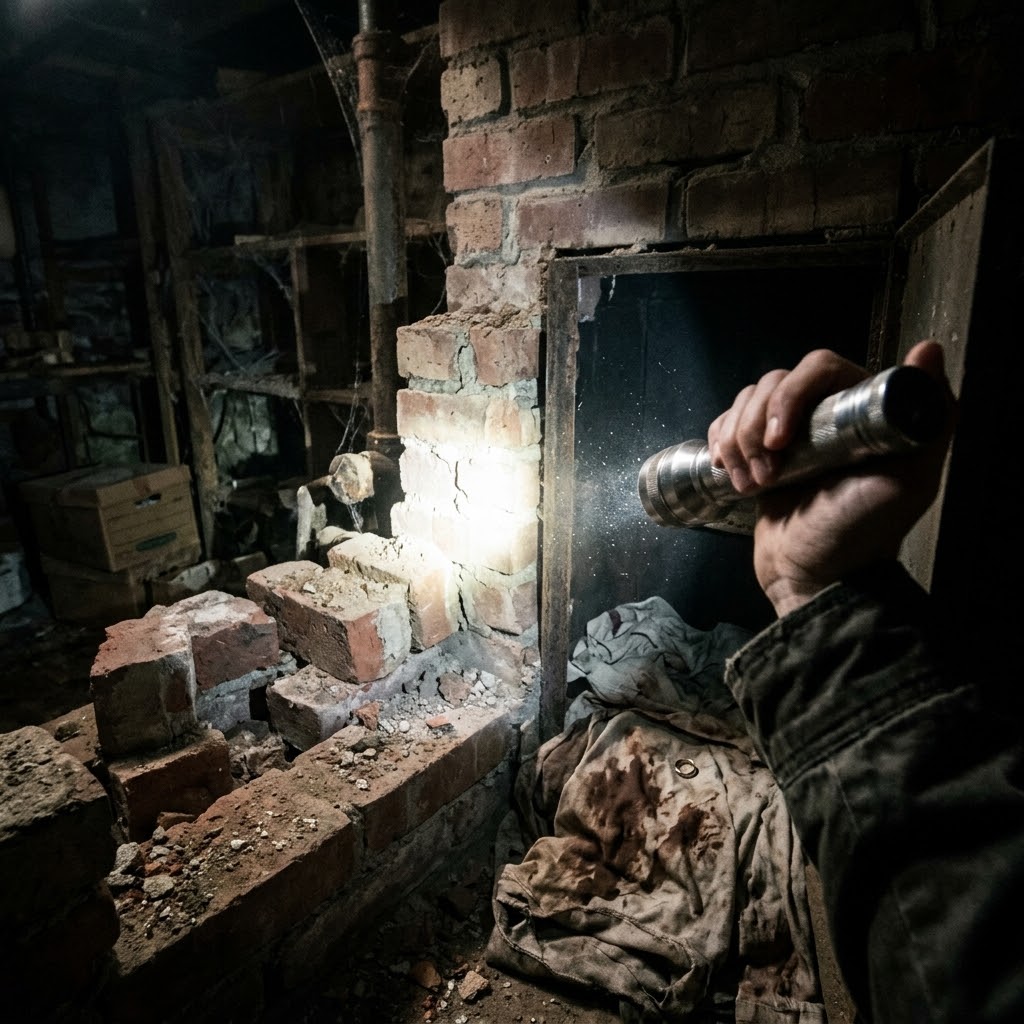
Arthur survived, but the six months he had spent imprisoned left him with a long and difficult recovery ahead. Medical professionals treated his immediate needs while investigators worked to establish a clear account of what had happened. The authorities described the hidden room as a confined space that appeared to have been deliberately reinforced and insulated. Its design, the condition in which Arthur was found, and the other evidence collected from the property would all become part of the investigation. Barbara was arrested that night, and the case moved from neighborhood speculation into the hands of the criminal justice system. She did not offer a public explanation that could undo what had been discovered. The woman who had once stood at the curb smiling in her pink robe was now facing serious allegations related to unlawful confinement and the destruction of evidence. As the investigation continued, the Vances focused on their son rather than the growing attention surrounding the house. Arthur had to regain his strength, process what had happened, and begin rebuilding a life that had been taken from him in ways no one could easily measure. His parents visited him, bringing familiar photographs and small comforts from the world he had been cut off from. They did not demand that he recount every detail of his ordeal. They understood that recovery would require time, medical support, and the freedom to speak when he was ready. The missing-person notice that had once seemed like a desperate plea became a record of the months in which his family had searched for him. For those of us who lived nearby, the news changed the way we remembered the previous half year. We thought of the mornings when Barbara had hauled another bag to the curb, the friendly exchanges we had shared, and the times we had watched her walk back into the house without suspecting that someone was being held against his will. The garbage bags had not been a random habit or a harmless effort to tidy a home after a breakup. They had been part of a calculated attempt to destroy Arthur’s belongings and make his absence appear permanent. Every ruined suit and smashed photograph had removed another piece of his visible life, while the hidden room kept him out of sight. Barbara had relied on a simple assumption: that people would believe what they saw on the surface. A clean house suggested order. A friendly smile suggested kindness. A calm explanation suggested that a missing husband had chosen to leave. None of those appearances revealed what was happening behind the door. I began to understand that the most frightening part of the story was how ordinary it had looked from the street. There had been no dramatic warning, no obvious sign that would have made the truth immediately clear. There had only been a pattern that felt increasingly wrong, and a moment when curiosity led me to look inside a torn garbage bag. I could have walked away and forgotten the photograph. I could have accepted Barbara’s explanation when she told me Arthur had made his choice. Instead, I had written down what I observed and contacted the investigator when the details no longer made sense. I did not solve the case, and I did not discover Arthur alone. The police investigation and his family’s persistence were essential to finding him. But reporting what I had seen gave the authorities another piece of information to consider. Sometimes, that is all a person can contribute: a clear account of what happened, offered without exaggeration and without pretending to know more than the evidence supports. In Arthur’s case, the truth was eventually found behind a door that had been kept shut for far too long.
Months later, Barbara’s house stood empty. The flowers that had once lined the walkway began to wither, and weeds appeared along the edges of the lawn. The curtains remained drawn, and the driveway where her car had once sat became a quiet patch of concrete. Neighbors gradually stopped gathering to discuss the case, though the story continued to surface whenever someone new moved onto the street. Official proceedings would determine Barbara’s legal responsibility, and I learned not to confuse the rumors that circulated among neighbors with the facts established by investigators and the courts. What I knew firsthand was enough to stay with me: the heavy bags, the torn photograph, the conversation with Mrs. Vance, and the night police officers descended into the basement and came back up calling for medical help. I also remembered Arthur’s mother standing on the porch, pleading for permission to search the place where she believed the answers might be hidden. Her determination had never been dramatic. She had simply refused to accept an explanation that did not fit the evidence, even when the person giving it insisted that the matter was settled. Her persistence, together with the work of the authorities, had helped keep the search alive until Arthur was found. I occasionally wondered what would have happened if I had never noticed the split in that first garbage bag. Perhaps another clue would have surfaced. Perhaps the police would have uncovered the hidden room through a different route. I could not know, and I did not want to turn uncertainty into a claim that one moment had changed everything. What I could say was that the photograph made me pay attention, and paying attention led me to report information that mattered. That experience changed the way I thought about the people around me. I did not begin treating every quiet neighbor as a suspect or every unusual habit as evidence of a crime. Suspicion without facts can hurt innocent people, and privacy matters. But I also learned that politeness should not require us to ignore credible signs of distress, and that an explanation is not necessarily the truth simply because it is delivered calmly. We can respect another person’s privacy while still reporting genuine concerns to the appropriate authorities. We can acknowledge what we do not know without pretending that what we have seen is meaningless. Most importantly, we can resist the temptation to dismiss someone else’s fear because the story is inconvenient or uncomfortable. Every Tuesday morning, when the garbage truck rolled down our street, I found myself glancing toward Barbara’s empty driveway. I remembered the bags being lifted into the compactor, the wedding photograph with Arthur’s face scratched out, and the strange sense that I had glimpsed a life being erased. I no longer saw those memories as a reason to fear every ordinary smile. Instead, they reminded me that appearances tell only part of a story, and that the truth sometimes depends on someone being willing to ask one more question. Barbara had spent months trying to remove every trace of Arthur from her home, but she had not been able to erase the concern of his family or the small pieces of evidence left behind. Arthur was found because people kept looking, kept asking, and eventually brought their concerns to those who could investigate. The house may have stood empty, and the neighborhood may have returned to its familiar routines, but I never forgot what had happened behind its perfect lawn and closed curtains. The most unsettling secrets are not always hidden in abandoned buildings or distant places. Sometimes, they exist behind the front doors we pass every day. And sometimes, the first step toward uncovering them is simply refusing to look away when something does not seem right.
