
PART 1: THE NEW WOMAN WHO REFUSED TO BOW

The moment the new inmate stepped through the gates of Blackwood Correctional Facility, every conversation in the women’s prison seemed to fade away.
She was different from the others.
Her name was Elena Carter. She was thirty-four years old, with dark hair tied tightly behind her head, a small scar running along her left eyebrow, and tattoos covering both arms, disappearing beneath the sleeves of her prison uniform. She carried no photographs, no letters, and no personal belongings except the few items the guards had handed her.
Most newcomers arrived frightened. Some cried during their first night. Others desperately tried to make friends, hoping that a familiar face might help them survive the unfamiliar world behind the walls.
Elena did none of those things.
She listened carefully to the guards, followed every instruction, and walked down the corridor without looking around in panic. Her expression revealed almost nothing.
That silence immediately attracted attention.
“Who is she?” one inmate whispered from behind the bars of her cell.
“Someone who doesn’t know where she’s landed,” another answered.
An older woman sitting on the edge of her bed shook her head.
“No. Look at her eyes. That woman knows exactly where she is.”
Nobody knew Elena’s story. Nobody knew why she had been sentenced to prison or what she had done before arriving at Blackwood. The documents accompanying her transfer were sealed, and the guards offered no explanation beyond the usual instructions.
But there was one thing Elena understood before the end of her first afternoon.
Blackwood had its own rules.
And the woman who enforced those rules wasn’t wearing a uniform.
Her name was Vanessa Reed.
For nearly eight years, Vanessa had been the most feared inmate in the entire facility. She was tall, broad-shouldered, and physically powerful, with a deep voice that could silence an entire room. A dark tattoo stretched from her neck to her right shoulder, and a pale scar crossed her chin.
Her reputation had grown so powerful that even inmates who had never spoken to her were afraid of attracting her attention.
Vanessa had created a small kingdom inside Blackwood.
Some inmates washed her clothes. Others cleaned her sleeping area, saved her the best portions of their meals, or completed unpleasant tasks simply because they were terrified of refusing her.
Whenever someone challenged her authority, Vanessa made certain that everyone witnessed the consequences.
She rarely needed to raise her voice.
Sometimes, all it took was a look.
The other women had learned to recognize the warning signs. When Vanessa entered a room, conversations became quieter. When she approached a table, people moved their belongings aside. And when she selected someone as her next target, the safest choice seemed to be pretending nothing was happening.
Even the guards had grown accustomed to her influence. They occasionally intervened when a situation became impossible to ignore, but Vanessa understood how to operate just beneath the threshold that would trigger serious consequences.
She knew which inmates were too frightened to report her.
She knew which witnesses would remain silent.
Most importantly, she believed nobody inside Blackwood could challenge her and walk away with their dignity intact.
For the first three days, Elena attracted little direct attention from Vanessa.
Elena spent her mornings reading old paperback books in the common room. She exercised quietly in the recreation yard and rarely joined conversations. When other inmates asked questions, she answered politely without offering personal details.
She never boasted about her past.
She never tried to appear dangerous.
And she never showed any interest in Vanessa’s little kingdom.
That last detail irritated Vanessa more than she cared to admit.
One afternoon, she watched Elena from across the recreation yard.
“That new girl,” Vanessa said to a woman sitting beside her. “What’s her problem?”
The woman followed her gaze.
“I don’t know. She keeps to herself.”
“Everybody has a problem.”
“Maybe she just wants to be left alone.”
Vanessa turned toward her so sharply that the woman immediately lowered her eyes.
“Did I ask what you think?”
“No.”
“Then don’t think out loud.”
The woman fell silent.
Vanessa continued watching Elena, who was walking along the fence with her hands behind her back. There was something irritating about the newcomer’s calmness. She didn’t look around to see who was watching. She didn’t rush when the guards called for the inmates to return indoors. She behaved as though Vanessa’s reputation meant absolutely nothing to her.
Vanessa decided that would have to change.
The following day, the opportunity arrived during lunch.
The dining hall was crowded. Metal trays clattered against tables, chairs scraped across the floor, and dozens of women spoke in low voices while waiting for their food.
Elena collected her tray and chose a seat near the far wall.
Her meal consisted of rice, vegetables, and a small portion of meat. She had barely taken three bites when the atmosphere around her began to change.
A woman at the next table stopped talking.
Another inmate quietly moved her cup out of the way.
Someone whispered, “She’s coming.”
Elena continued eating.
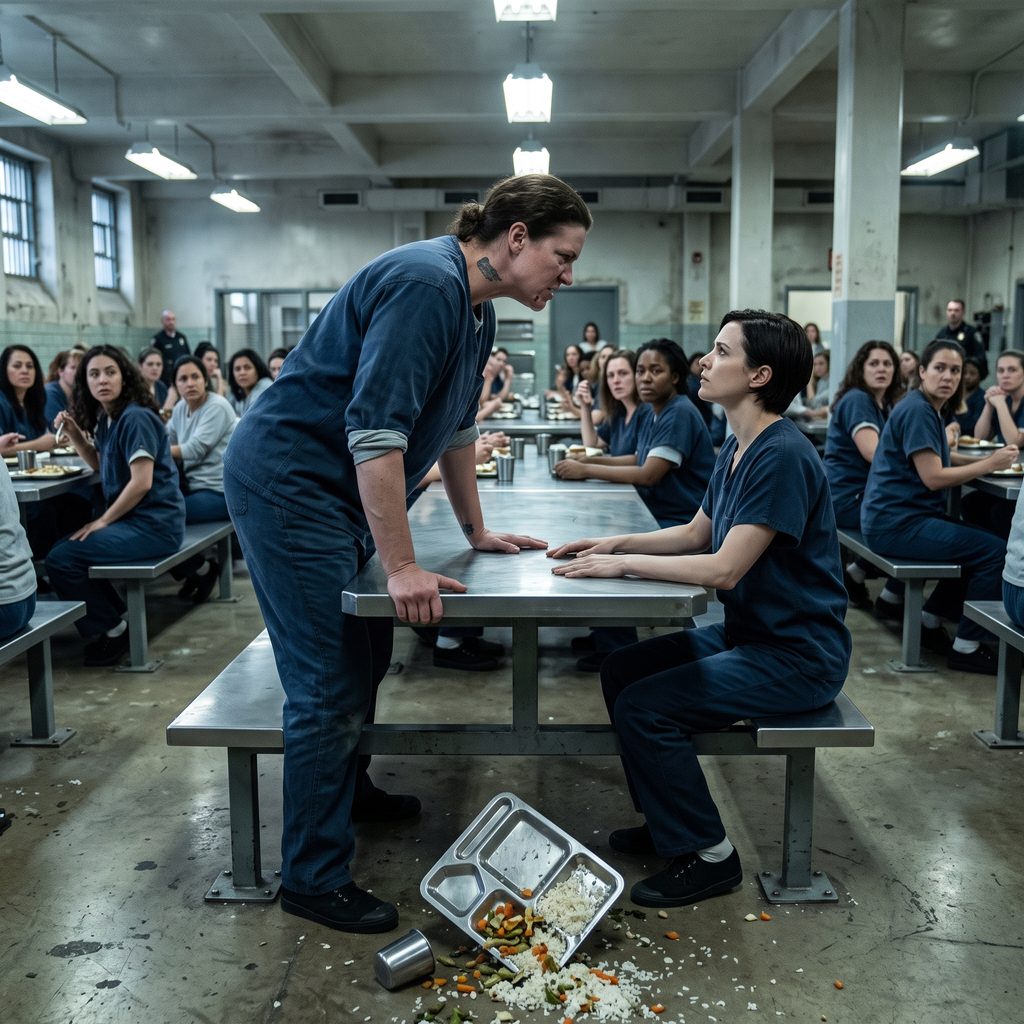
Vanessa walked toward her with two companions following a few steps behind. Her heavy boots struck the floor with deliberate confidence.
She stopped directly in front of Elena’s table and looked down at the tray.
“That’s a nice lunch,” Vanessa said.
Elena raised her eyes.
“Is there something you need?”
Vanessa smiled.
“Yes. Your food.”
For a moment, Elena simply looked at her.
“Your tray is over there,” she replied, nodding toward the serving counter.
A few inmates exchanged nervous glances.
Nobody spoke to Vanessa like that.
Vanessa placed both hands on the table and leaned forward.
“Maybe you didn’t hear me. I said I want your food.”
“I heard you.”
“Then give it to me.”
Elena set down her fork.
“No.”
The word was quiet, but it carried across the table with unmistakable clarity.
For several seconds, the dining hall seemed to hold its breath.
Vanessa straightened slowly.
“Do you know who you’re talking to?”
“I’m talking to someone who wants to take my lunch.”
A nervous laugh escaped from somewhere near the back of the room before immediately disappearing.
Vanessa’s face hardened.
She had expected tears, excuses, perhaps a frightened apology. She had not expected a calm refusal delivered without a trace of anger.
She grabbed Elena’s tray.
“Let’s see how brave you are when you don’t have anything to eat.”
With one violent movement, she swept the tray off the table.
Rice scattered across the floor. The vegetables landed beneath a nearby bench, and the plastic cup rolled several feet before stopping against a chair leg.
A wave of shocked whispers passed through the room.
Vanessa stood over Elena, enjoying the attention.
“Now what?” she asked. “Are you going to cry?”
Elena looked at the food scattered across the floor.
Then she slowly lifted her eyes toward Vanessa.
“No,” she answered.
Vanessa’s smile faltered.
“No?”
Elena stood up.
“No. But you’re going to pick that up.”
The words struck the room like a thunderclap.
Vanessa stared at her, unable to believe what she had heard.
For eight years, people had lowered their heads to avoid confronting her. Some had surrendered their food before she even asked. Others had apologized simply because she happened to walk past their tables.
Yet this newcomer was standing directly in front of her, calmly demanding that she clean up the mess she had made.
Vanessa stepped closer.
“You have five seconds to get on your knees and apologize.”
Elena didn’t move.
“One,” Vanessa said.
The newcomer remained silent.
“Two.”
Several inmates began edging away from the table.
“Three.”
Elena looked directly into Vanessa’s eyes.
“You’ve made your point,” she said. “Now step aside.”
Vanessa’s expression twisted with rage.
Nobody had ever dismissed her like that.
She reached forward and grabbed Elena by the shoulder, intending to drag her away from the table and force her to kneel in front of everyone.
But the instant her fingers tightened, Elena’s expression changed.
Not into fear.
Not into anger.
Into something colder and more focused.
“Take your hand off me,” Elena warned.
Vanessa laughed.
“Or what?”
Elena said nothing.
Vanessa pulled harder.
And that was the moment she made the mistake that would change everything inside Blackwood Correctional Facility.
Because the quiet woman she had chosen to humiliate was not the helpless newcomer she imagined.
Elena had spent years learning how to remain calm when other people lost control.
And as Vanessa prepared to strike, Elena knew she would have to reveal a part of herself she had hoped to leave behind.
The entire dining hall watched.
Nobody dared to breathe.
Then Vanessa threw her first punch.
And Elena moved.
PART 2: THE FIGHT THAT SILENCED THE ENTIRE PRISON

The punch cut through the air with a sudden, angry motion.
Several inmates screamed.
But the blow never reached Elena’s face.
She shifted just enough to avoid it, allowing Vanessa’s momentum to carry her forward. The larger woman stumbled, caught herself against the edge of the table, and spun around with disbelief written across her face.
For a brief moment, neither woman moved.
Elena stood in the same place, her breathing steady.
Vanessa stared at her.
“What was that?”
Elena glanced toward the nearest guard station.
“Stop this before someone gets hurt.”
The calmness in her voice made Vanessa even angrier.
She lunged again, this time attempting to grab Elena around the upper body. Elena stepped sideways, caught her arm, and redirected the movement. Vanessa lost her balance and struck the table with her hip.
Metal trays crashed to the floor.
The dining hall erupted into shouting.
“Break it up!”
“Get the guards!”
“What’s happening?”
Two officers rushed through the entrance, but before they could reach the women, Vanessa charged again.
This time, Elena moved with unmistakable precision.
She turned, controlled Vanessa’s arm, and used the larger woman’s forward movement to bring her down onto the padded side of a nearby bench. Vanessa hit hard enough to knock the breath from her lungs.
Elena immediately released her and stepped back.
She didn’t strike her while she was down.
She didn’t insult her.
She simply created distance and waited.
The silence that followed was almost more shocking than the fight itself.
Vanessa slowly pushed herself upright.
Her face had turned red with humiliation.
For the first time in eight years, someone had stopped her without begging, pleading, or surrendering.
And that someone had done it in front of every inmate in the dining hall.
“You think you’re better than me?” Vanessa shouted.
“No,” Elena replied. “I think you should leave people alone.”
The answer made Vanessa lose whatever control remained.
She rushed forward a third time, ignoring the officers who were now ordering her to stop. Elena blocked her approach and guided her away from the table. When Vanessa tried to force her down, Elena shifted her weight and brought her safely to the floor again.
The guards finally reached them.
“Hands where we can see them! Both of you!”
Elena stepped away immediately and raised her hands.
Vanessa struggled against the officers, shouting that the newcomer had attacked her without reason.
Several inmates had witnessed everything.
They had seen Vanessa demand the food.
They had watched her throw the tray onto the floor.
And they had seen her throw the first punch.
For once, the truth was impossible to hide.
The officers separated the two women and escorted them to different rooms for questioning.
As Elena walked away, she could hear whispers following her down the corridor.
“Who is she?”
“Did you see how she moved?”
“Vanessa didn’t even touch her.”
“Nobody has ever done that before.”
Elena ignored the questions.
She knew what would happen next.
Vanessa would not accept this defeat quietly.
Inside a small interview room, Officer Daniels placed a glass of water on the table and sat opposite Elena.
“Start from the beginning,” he said.
Elena explained what had happened, describing Vanessa’s demand, the destruction of her meal, and the physical attack that followed.
Daniels listened carefully.
“Why didn’t you back away?”
“I was sitting at a table eating my lunch. She demanded that I surrender it, and then she attacked me.”
“You could have walked away.”
“I could have. But that wouldn’t have changed anything.”
The officer leaned back.
“What do you mean?”
Elena considered her answer.
“How many other women has she done this to?”
Daniels didn’t respond immediately.
His silence told her more than any explanation could have.
He had worked at Blackwood for twelve years. He knew Vanessa’s reputation, and he had heard complaints before. But most complaints disappeared when witnesses changed their stories or refused to provide statements.
“Listen,” Daniels said finally. “I don’t know your background, and I don’t need to know every detail. But this facility has procedures. You cannot take matters into your own hands.”
“I understand.”
“Do you?”
“Yes. That’s why I stopped when you told me to.”
Daniels studied her for several seconds.
There was something unusual about the way Elena answered questions. She was neither defensive nor eager to impress him. She didn’t exaggerate what she had done, and she didn’t seem interested in proving that she could beat Vanessa.
She appeared to regret that the confrontation had happened at all.
“One more question,” he said. “Where did you learn to defend yourself like that?”
Elena looked down at her hands.
“Before I came here, I had another life.”
“That doesn’t answer my question.”
“It’s the only answer I’m ready to give.”
Daniels closed his notebook.
He could have pressed further, but the facility had already received unusual instructions regarding Elena’s transfer. Her file was restricted, and senior administration had ordered staff to avoid discussing her history with other inmates.
He had assumed the restrictions concerned the nature of her conviction.
Now he wondered whether there was more to the story.
Meanwhile, Vanessa was sitting in another interview room, furious and humiliated.
A female officer asked her to explain why she had approached Elena’s table.
“I was joking with her,” Vanessa insisted.
“Did you take her tray?”
“No.”
“Several witnesses say you threw her food onto the floor.”
“They’re lying.”
“Did you strike her first?”
Vanessa clenched her jaw.
The officer placed several written statements on the table.
“Three independent witnesses have described the same sequence of events. You may want to reconsider your account.”
Vanessa looked at the papers without touching them.
For the first time, she realized that her reputation might not protect her.
The other inmates had seen what happened.
And some of them were no longer willing to remain silent.
When the questioning ended, Vanessa was escorted to a temporary holding cell while the officers reviewed the incident. Elena was returned to her assigned area, where the other inmates watched her with a mixture of curiosity and disbelief.
An elderly inmate named Ruth approached her.
Ruth had been at Blackwood for nearly twenty years. She was small, thin, and careful with her words. Unlike many of the other women, she had never surrendered completely to Vanessa’s demands, although she had learned how to avoid attracting her attention.
“You shouldn’t have done that,” Ruth whispered.
Elena looked at her.
“You mean defending myself?”
“I mean making her look weak.”
“She did that herself.”
Ruth glanced toward the corridor.
“You don’t understand how this place works. Vanessa has friends. She has people who owe her favors. And she never forgets a humiliation.”
“Then she should learn to stop humiliating other people.”
Ruth almost smiled.
“You speak as though the world is simple.”
“No,” Elena replied. “I speak as though certain things are wrong.”
For a moment, Ruth studied the newcomer more carefully.
There was something familiar about her voice, something steady and deliberate. Ruth had heard officers speak that way during difficult situations. She had also seen investigators question dangerous people without raising their voices.
“Who were you before prison?” Ruth asked.
Elena’s expression grew distant.
“Someone who made mistakes.”
“Everybody here has made mistakes.”
“Not all mistakes are the same.”
Before Ruth could ask another question, a guard called for the inmates to return to their cells.
That evening, the prison administration issued a warning to Vanessa and placed her under closer observation. The official report described the dining hall confrontation as an altercation involving two inmates.
But the women who had witnessed it knew the story was much bigger.
For the first time, Vanessa’s authority had been challenged publicly.
And the newcomer had not been punished for refusing to surrender her meal.
That fact spread through Blackwood faster than any rumor before it.
Yet the most surprising development came after midnight.
A senior officer arrived at Elena’s cell carrying a sealed envelope.
“Pack your belongings,” he said.
Elena looked up from her book.
“Why?”
“Administration wants to speak with you first thing tomorrow morning.”
“About the incident?”
The officer hesitated.
“Not exactly.”
He handed her the envelope.
Across the front, someone had written her full name in black ink.
ELENA MARIE CARTER.
Beneath it was a second line.
CONFIDENTIAL — AUTHORIZED PERSONNEL ONLY.
Elena stared at the envelope for a long time.
She knew exactly what it meant.
Someone had finally decided that her past could no longer remain hidden.
And when the prison learned the truth about who she really was, Vanessa would discover that the woman she had tried to humiliate was connected to a story far more complicated than a fight over lunch.
PART 3: THE SECRET BEHIND ELENA CARTER
At six the following morning, Elena was escorted to the administration building.
Unlike the rest of Blackwood, the building was quiet and brightly lit. Its corridors smelled of disinfectant and fresh coffee, and framed photographs of former wardens lined the walls.
Elena walked between two officers without asking questions.
At the end of the corridor, they entered a conference room where Warden Margaret Collins was waiting.
Collins was a woman in her early sixties, with silver hair, sharp eyes, and the controlled expression of someone who had spent decades managing difficult situations.
A thick file lay open on the table.
“Sit down, Ms. Carter,” she said.
Elena took the chair opposite her.
“I understand there was an incident yesterday.”
“Yes.”
“And I understand you had several opportunities to walk away.”
“I also had several opportunities to be struck without defending myself.”
The warden folded her hands.
“I’m not questioning whether you had the right to protect yourself. The officers are reviewing the incident, and the witnesses have been interviewed. That’s not why I asked to see you.”
She turned the file around.
Inside were photographs, official documents, and several newspaper clippings.
Elena recognized the first photograph immediately.
It showed her wearing a dark uniform, standing beside a group of officers outside a training facility.
For the first time since arriving at Blackwood, her composure seemed to falter.
“Where did you get that?” she asked.
“It’s part of your verified professional history.”
Collins tapped the photograph.
“Before your conviction, you served as a senior tactical instructor in a federal law enforcement unit. Your record includes advanced defensive training, crisis negotiation, and several years of operational experience.”
Elena said nothing.
“Your transfer documentation also includes restrictions regarding the disclosure of certain professional details. I assume you understand why.”
“Yes.”
“Then you understand why the staff are asking questions.”
Elena looked toward the window.
“I didn’t come here to demonstrate anything.”
“I believe you.”
The warden paused.
“But yesterday’s incident has raised another concern. Several inmates have submitted statements describing a pattern of intimidation, theft, and threats involving Vanessa Reed. Some of these allegations are years old.”
“Then investigate them.”
“We intend to.”
“Good.”
Collins studied Elena.
“You understand that your past does not give you special authority inside this facility.”
“I never claimed it did.”
“And your training does not excuse unnecessary violence.”
“It shouldn’t.”
The warden closed the file.
“Then perhaps we understand each other.”
Elena stood when the meeting ended.
Before she reached the door, Collins spoke again.
“Ms. Carter, one question. Why did you remain calm yesterday when Vanessa was trying so hard to provoke you?”
Elena stopped.
For several seconds, she seemed to be listening to a voice only she could hear.
“Because I’ve seen what happens when people confuse anger with strength,” she finally said. “And I’ve spent too much of my life trying to repair the damage that confusion causes.”
Then she left.
The meeting should have brought the matter to an end.
Instead, it marked the beginning of a much larger change inside Blackwood.
During the following days, administrators began reviewing old incident reports. Inmates who had previously refused to cooperate started submitting statements. Some described missing meals. Others reported threats, stolen belongings, and pressure to perform personal tasks for Vanessa and her associates.
The reports revealed a disturbing pattern.
Vanessa had not built her reputation through strength alone.
She had built it through silence.
She understood that frightened people rarely challenged the person they feared. By humiliating one inmate in front of twenty others, she could discourage all twenty from speaking up.
But the incident with Elena had broken something in that system.
The women had seen Vanessa lose control.
More importantly, they had seen that someone could resist her without becoming cruel in return.
Ruth was among the first to provide a formal statement.
She described an incident from three years earlier when Vanessa had threatened a younger inmate over a missing blanket. The woman had been so frightened that she stopped eating regularly and eventually requested a transfer to another unit.
Another inmate reported that Vanessa had repeatedly taken food from women who received additional portions for medical or dietary reasons.
A third described being pressured to clean Vanessa’s area in exchange for being left alone.
Each statement added another piece to the picture.
Vanessa, meanwhile, noticed the change almost immediately.
Women who once moved aside for her now looked directly at her.
Some stopped answering when she gave orders.
Others simply walked away.
Her companions became increasingly nervous. They had followed her for years because they believed her influence would protect them. Now they wondered whether their association with her might bring consequences of its own.
Vanessa blamed Elena for everything.
She convinced herself that if the newcomer had simply surrendered her food, none of this would have happened.
In her mind, the original humiliation mattered more than the years of fear she had created.
One afternoon, Vanessa saw Elena in the library.
Elena was sitting beside a window, reading a paperback novel. The room was quiet except for the occasional turning of a page.
Vanessa approached without her usual companions.
“Enjoying your new popularity?” she asked.
Elena didn’t immediately look up.
“I’m reading.”
“You think you’ve changed something?”
Elena closed the book around one finger.
“I didn’t start this investigation.”
“You made me look weak.”
“No. You tried to take my food, and I refused.”
Vanessa leaned forward.
“You should have known better.”
Elena’s eyes hardened slightly.
“Known what? That you expected everyone to be afraid of you?”
Vanessa glanced toward the door.
For a moment, her expression revealed something beneath the anger.
Fear.
Not fear of Elena’s physical abilities, although she had reason to respect them.
Fear of losing the only identity she had built for herself.
For years, Vanessa had convinced herself that control was the same as respect. She had learned to interpret obedience as proof of her importance. Every frightened glance reassured her that she mattered.
Now those glances were disappearing.
“You don’t know anything about me,” Vanessa said.
“You’re right.”
“Then stop acting as if you understand.”
Elena considered her for a moment.
“I don’t know your past. I don’t know what brought you here. But I know what you did yesterday.”
Vanessa’s jaw tightened.
“And what if I do it again?”
“Then you’ll have to answer for it again.”
The answer offered no threat, no promise of revenge, and no opportunity for Vanessa to turn the conversation into another contest of intimidation.
That made it harder to bear.
Vanessa stepped away.
As she walked toward the door, Elena returned to her book.
She did not follow her.
She did not celebrate.
And she did not realize that Ruth, sitting at a nearby table, had heard every word.
That evening, Ruth approached Elena in the common room.
“I heard what you said to her.”
Elena turned a page.
“Which part?”
“The part about answering for what she does.”
Ruth sat down.
“I used to think the only way to survive this place was to keep my head down. If someone took something from me, I told myself it wasn’t worth the trouble. If someone threatened me, I pretended I hadn’t heard.”
She looked at her hands.
“After a while, you stop remembering what it feels like to say no.”
Elena closed the book.
“That isn’t your fault.”
“Maybe not. But I helped her.”
“You survived.”
Ruth shook her head.
“I want to do more than survive now.”
She had already submitted her statement to the administration. Two other inmates had agreed to confirm parts of her account.
Elena listened without interrupting.
When Ruth finished, she offered a small nod.
“Then tell the truth. Let the people responsible for investigating do their work.”
Ruth smiled faintly.
“You really aren’t interested in becoming the new Vanessa, are you?”
“No.”
“Why not?”
Elena looked around the room.
“Because if people have to fear me before they can respect me, then I’ve accomplished nothing.”
Ruth was silent for a long moment.
Then she stood.
For the first time in years, she walked across the common room without checking whether Vanessa was watching.
It was a small gesture.
But other women noticed.
And the next morning, three more inmates requested meetings with the warden.
The investigation continued, and Vanessa’s position grew increasingly fragile.
Yet Elena still carried a private burden that no one inside Blackwood understood.
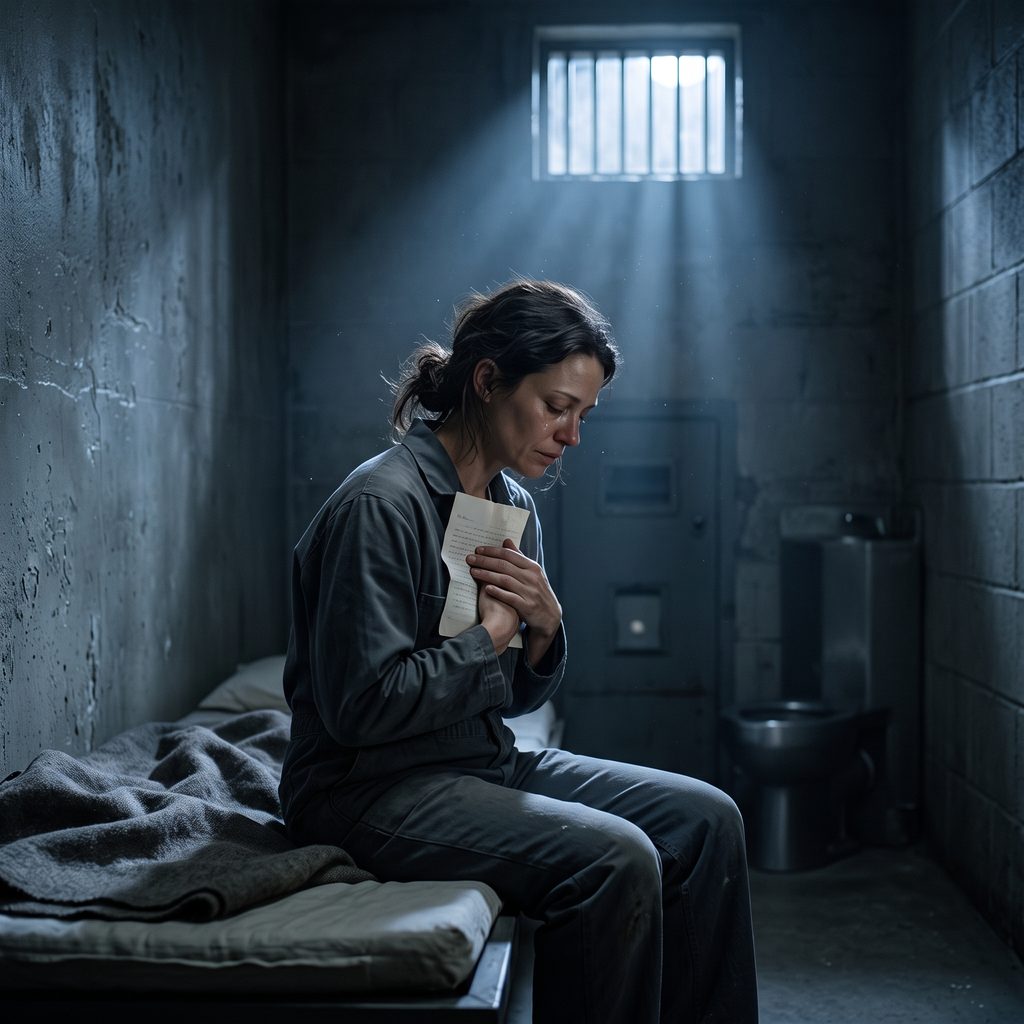
That night, after lights-out, she took a folded letter from inside her book.
The paper had been handled so many times that its edges were soft and worn.
It was a letter from her younger sister, Sophie.
The final paragraph was written in hurried handwriting.
I know you made mistakes, Elena. I know you can’t change what happened. But please don’t let the worst day of your life become the only thing you believe about yourself.
Elena read the words twice.
Then she folded the letter and pressed it against her chest.
For the first time since arriving at Blackwood, tears filled her eyes.
Nobody could see her in the darkness.
Nobody knew that beneath her discipline, training, and quiet confidence lived a woman still struggling to forgive herself.
She had not entered prison because she enjoyed violence.
She had entered because, years earlier, she had made a decision during a crisis that changed several lives forever.
And she had spent every day since trying to understand the difference between protecting someone and controlling what happened next.
Vanessa had mistaken Elena’s restraint for weakness.
But Elena knew that restraint was often the hardest thing a person could learn.
The question now was whether Vanessa would ever understand it too.
PART 4: THE DAY EVERYONE FINALLY SPOKE
The official hearing took place ten days after the dining hall incident.
The administration had gathered statements from inmates, reviewed available surveillance footage, and examined previous disciplinary reports involving Vanessa.
The evidence revealed a consistent pattern of intimidation.
Several incidents had never been formally investigated because witnesses had withdrawn their complaints. Others had been dismissed as ordinary disagreements between inmates.
This time, however, the witnesses had agreed to stand by their statements.
Vanessa entered the hearing room with her head held high.
She still hoped that her reputation would protect her.
Warden Collins sat at the head of the table, accompanied by two senior officers and a disciplinary review representative.
“Vanessa Reed,” Collins began, “you have been asked to respond to allegations of intimidation, coercion, and repeated interference with other inmates’ access to their meals and personal belongings.”
Vanessa crossed her arms.
“People are exaggerating.”
“Then you will have an opportunity to address each allegation.”
One by one, the statements were read.
Ruth described how Vanessa had threatened her over a blanket.
Another inmate explained how her lunch had been taken repeatedly.
A younger woman spoke about being pressured into cleaning Vanessa’s sleeping area and warned that refusing would make her life miserable.
Vanessa interrupted several times.
“They’re lying!”
“They’re trying to get me into trouble!”
“Ask them what they did first!”
But the statements remained consistent, and the review representative repeatedly instructed her to allow the witnesses to finish.
Finally, the incident in the dining hall was addressed.
The officers confirmed that Vanessa had approached Elena, demanded her food, and thrown the tray to the floor after Elena refused.
Multiple witnesses supported the account.
When asked whether she had struck first, Vanessa looked toward Elena, who had been called to provide a statement.
Elena sat quietly near the end of the table.
“Tell them what really happened,” Vanessa demanded.
Elena looked at the review representative.
“I’ve already given my statement.”
“Tell them again!”
Warden Collins raised a hand.
“Ms. Reed, you will not intimidate witnesses during this hearing.”
Vanessa fell silent.
Elena repeated the events in a measured voice. She did not embellish the confrontation, and she did not describe Vanessa as a monster.
She explained that Vanessa had taken her food, thrown it onto the floor, and attempted to strike her.
She acknowledged that she had used defensive techniques to stop the attack.
Then she added something nobody expected.
“I don’t believe the purpose of this hearing should be to punish Vanessa because she lost a fight. It should be to determine whether she has repeatedly harmed other inmates and whether the facility failed to address their complaints.”
The room became quiet.
The review representative studied her.
“Are you asking us to show her leniency?”
“No. I’m asking you to investigate the behavior, not just the confrontation.”
Vanessa stared at Elena.
She had expected her to demand punishment, perhaps even to describe how easily she could have caused serious injury.
Instead, Elena had refused to turn the hearing into a personal victory.
For a brief moment, Vanessa seemed unable to understand what she was seeing.
The hearing continued for another hour.
At its conclusion, the administration announced that Vanessa would face disciplinary consequences for the confirmed misconduct. Additional allegations would be handled through the facility’s established review process, and supervision in the affected unit would be strengthened.
The administration also introduced a confidential reporting procedure for inmates experiencing intimidation or coercion.
No one claimed that these measures would solve every problem overnight.
But for the first time, the women of Blackwood had a clear way to report abuse without having to confront Vanessa directly.
When the hearing ended, the inmates who had provided statements returned to their unit.
Ruth approached Elena in the corridor.
“Do you think anything will really change?”
Elena considered the question.
“Some things will change. Other things will take time.”
“And what happens when someone else tries to become like Vanessa?”
“Then the others will have to decide whether they want to let it happen.”
Ruth nodded slowly.
“I suppose that means we can’t just wait for someone else to stand up.”
“No,” Elena said. “It means we have to start standing up for one another.”
The following weeks were difficult.
Vanessa was moved to a different unit while the facility completed its review. Her former companions gradually distanced themselves from her, and the women who had once obeyed her began making their own decisions.
Some changes were small.
An inmate who had always eaten alone began sharing a table with two others.
A woman who used to surrender her dessert started keeping it.
Ruth began helping new arrivals understand the facility’s procedures, including how to request assistance from staff when they felt threatened.
Nobody pretended that Blackwood had suddenly become a peaceful place.
Arguments still occurred. People still disagreed. The prison remained a place where individuals carried painful histories and struggled with the consequences of their choices.
But fear was no longer the only language everyone understood.
Elena continued her daily routine.
She exercised, read, attended scheduled activities, and avoided unnecessary confrontations. She never tried to replace Vanessa as the person everyone watched.
When an inmate asked her to settle a disagreement, Elena directed her toward the appropriate staff member.
When someone praised her for defeating Vanessa, she corrected them.
“I didn’t win anything,” she said. “I defended myself.”
One afternoon, she found a fresh tray of food waiting on a table in the dining hall.
An inmate had placed it there after seeing Elena’s lunch scattered across the floor weeks earlier.
“You can sit with us,” the woman said.
Elena looked at the tray, then at the group of women gathered around the table.
For the first time since her arrival, she accepted an invitation without hesitation.
They talked about ordinary things: books, family visits, the weather, and the meals they missed from home.
Nobody asked Elena to explain her past.
Nobody demanded that she prove how strong she was.
For a while, she was simply another woman eating lunch.
Then, one morning, a letter arrived from Sophie.
Elena opened it carefully.
Dear Elena,
I received your last letter. I’m glad you’re finding ways to move forward. I know you still think about what happened, and I know you believe you should have been able to save everyone.
But you cannot change the past by punishing yourself forever.
You once told me that being strong meant taking responsibility for your decisions. I think you’re finally learning that it also means allowing yourself to become better.
I miss you. I hope one day we can sit together again without either of us feeling that we have to pretend everything is fine.
Until then, please keep going.
Love, Sophie.
Elena read the letter in silence.
Years earlier, she had believed that discipline could solve every problem. She had trusted training, preparation, and careful decisions to protect the people around her.
Then came the operation that changed her life.
A frightened young man had entered a building where several people were being held. Elena had been part of the team responsible for resolving the crisis. When the situation deteriorated, she made a decision that she believed would prevent further harm.
Instead, someone died.
The investigation that followed exposed mistakes, conflicting accounts, and failures of judgment. Elena accepted responsibility for her part in what happened, even though the full circumstances remained complicated.
Her conviction had ended her career and separated her from the life she had known.
For a long time, she believed that losing everything was the only punishment she deserved.
But Sophie’s letters had slowly taught her something different.
Taking responsibility did not mean refusing to change.
And regret, however painful, did not have to become a permanent identity.
Elena folded the letter and placed it carefully inside her book.
That evening, as the inmates returned from the recreation yard, she noticed Vanessa standing alone near the far end of the corridor.
Vanessa looked different without the crowd that had once followed her.
She appeared tired.
For several seconds, the two women regarded each other without speaking.
Then Vanessa approached.
“Can I ask you something?”
Elena waited.
“Why didn’t you humiliate me when you had the chance?”
Elena considered the question.
“Because you were already humiliating yourself.”
Vanessa looked away.
“I used to think if people feared me, nobody could hurt me.”
“Did it work?”
Vanessa gave a short, bitter laugh.
“No.”
Silence settled between them.
After a moment, Vanessa spoke again.
“When you threw me down in the dining hall, I thought you were trying to prove you were stronger than me.”
“I was trying to stop you from attacking me.”
“I know that now.”
She looked toward the other inmates, who were returning to their cells.
“They don’t look at me the same way anymore.”
“Maybe that’s a chance to do something differently.”
Vanessa’s eyes narrowed.
“You think people can change that easily?”
“No,” Elena answered. “I think changing is difficult. That’s why you have to choose it every day.”
Vanessa said nothing.
She had spent years believing that admitting a mistake was the same as surrendering power. Now she was beginning to understand that the refusal to admit mistakes had cost her far more than any opponent ever could.
“I took your food because I wanted everyone to see you obey me,” she said quietly.
“I know.”
“And you didn’t.”
“No.”
Vanessa swallowed.
“I’m sorry.”
The apology was awkward and incomplete. It did not erase what she had done, and it did not repair the damage caused by years of intimidation.
Elena did not pretend otherwise.
“Then start by not doing it again.”
Vanessa nodded once.
It was not a dramatic reconciliation.
There was no embrace, no sudden friendship, and no promise that everything would be forgiven.
There was only a small acknowledgment that something had gone wrong and that the next decision mattered.
In the months that followed, Vanessa’s behavior remained under close supervision. She still had to face the consequences of her actions, and trust did not return simply because she had apologized.
But the women of Blackwood no longer treated her as an unquestionable authority.
And Elena never forgot the lesson she had learned in the dining hall.
The moment Vanessa swept her food onto the floor, everyone had expected the newcomer to beg.
Instead, Elena had stood her ground.
Not because she wanted to rule the prison.
Not because she wanted revenge.
But because she understood that allowing someone to humiliate another person in public often teaches everyone watching that cruelty is acceptable.
The most powerful moment that day was not when Elena avoided the first punch.
It was when she chose not to strike back out of anger.
Months later, when a frightened newcomer entered Blackwood and accidentally sat at a table reserved by another inmate, the old tension began to rise.
A woman stood up and demanded that the newcomer move.
Several inmates watched nervously.
The newcomer lowered her eyes and began gathering her things.
Then Ruth stepped forward.
“She can finish her meal,” Ruth said firmly.
The other woman turned toward her.
“Stay out of this.”
“No,” Ruth replied. “There’s enough room for everyone.”
Another inmate joined Ruth.
Then another.
The woman who had demanded the seat looked around and realized that the room was no longer willing to remain silent.
She muttered something under her breath and walked away.
The newcomer sat back down.
Ruth offered her a reassuring smile.
“Eat your lunch,” she said. “Nobody has the right to take it from you.”
Across the room, Elena watched the exchange.
She said nothing.
She didn’t need to.
The change she had hoped to see was happening without her intervention. The women were learning that dignity did not have to depend on the approval of the strongest person in the room.
When the lunch bell rang, Elena collected her tray and walked toward the exit.
For the first time in a long while, she felt something close to peace.
She knew her own story was far from finished. There would still be difficult days, painful memories, and consequences she could not escape.
But she no longer believed that her worst moment had to define every moment that followed.
And somewhere behind her, in a dining hall where fear had once ruled every table, a new inmate was finishing her meal in peace.
Because true strength is not measured by how many people fear you. It is measured by what you choose to do when you have the power to hurt someone who cannot fight back.
